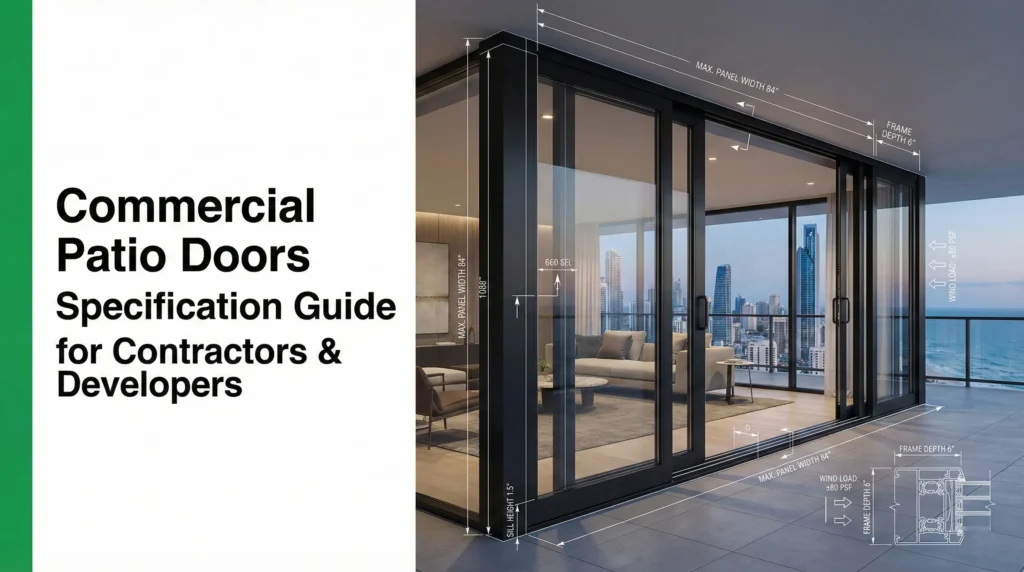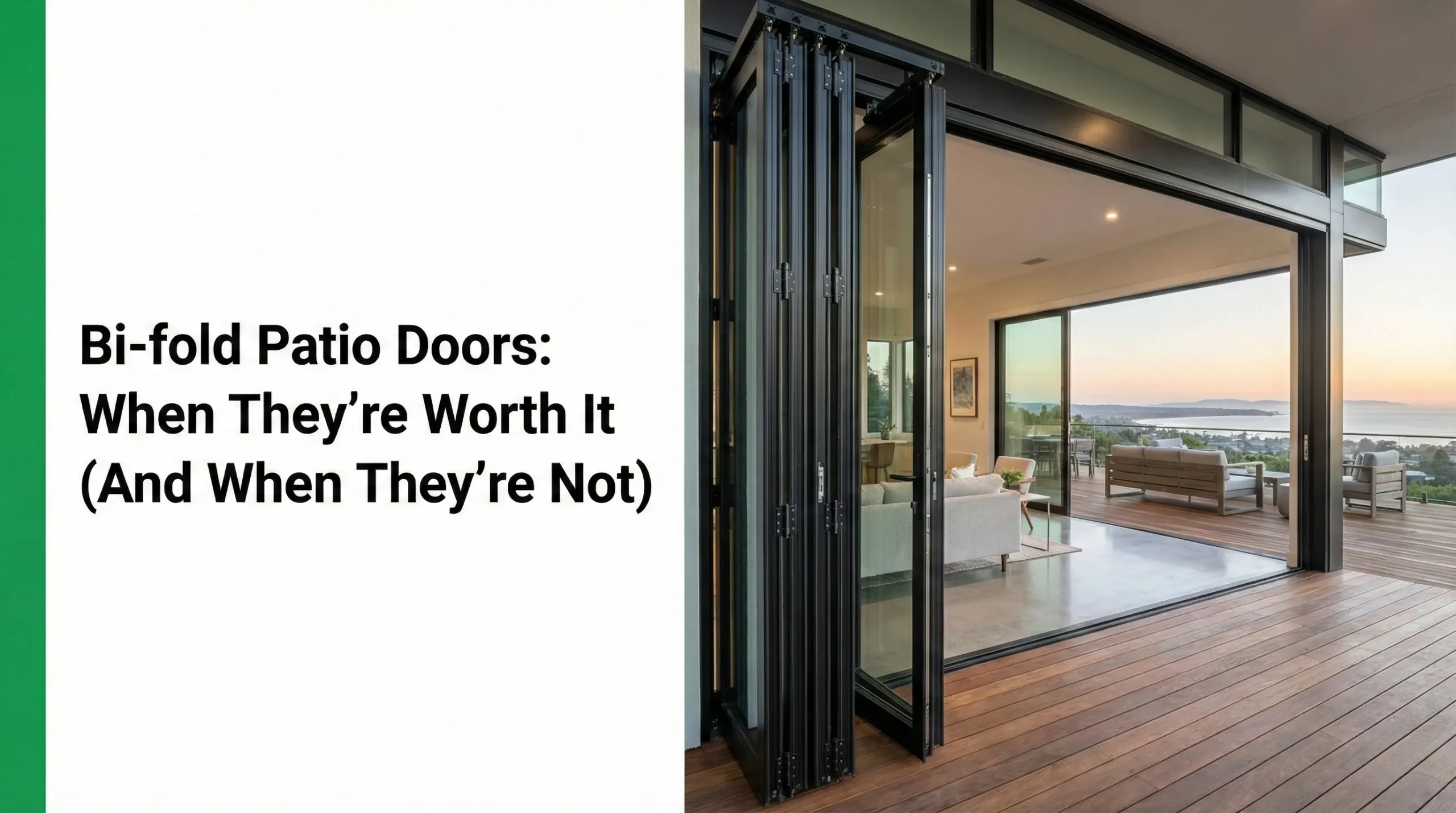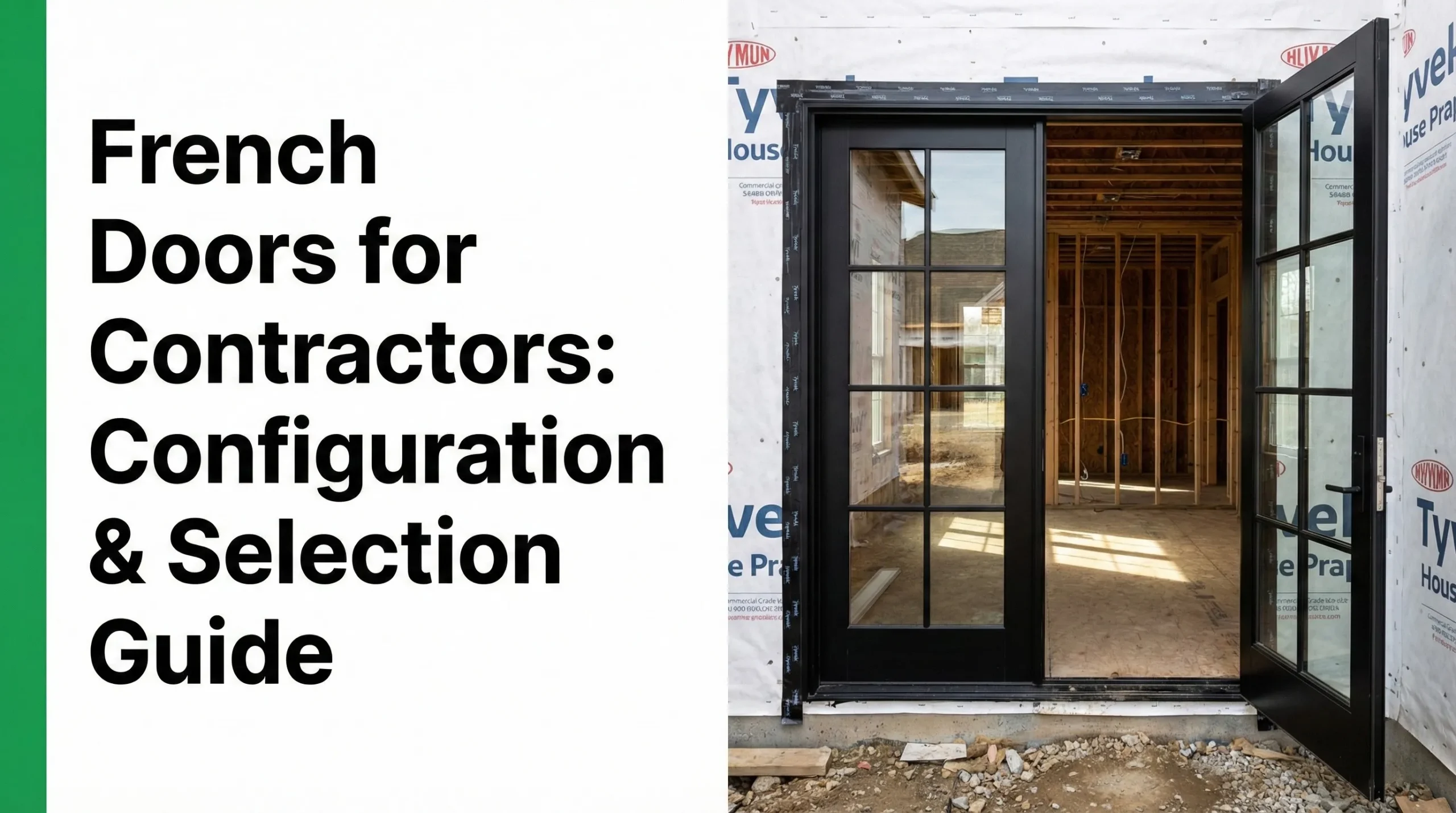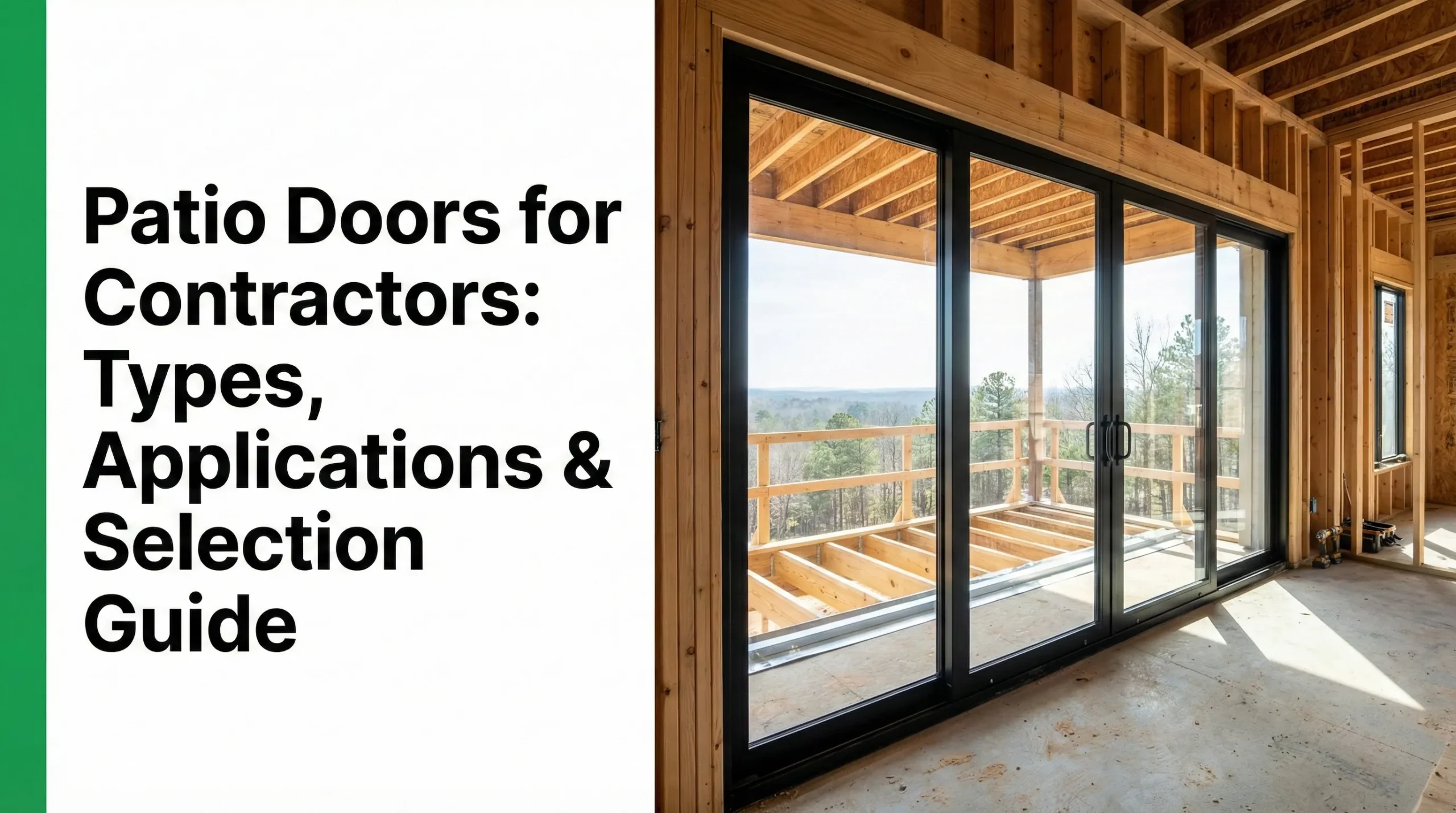
Bi-fold patio doors create dramatic indoor-outdoor connections—but they’re not the right choice for every project. They cost 2-3x more than sliding doors, require more space planning, and involve higher installation complexity. For contractors and builders, the critical question isn’t whether bi-fold doors look impressive (they do), but whether the premium cost and added complexity deliver enough value for the specific project.
This guide covers when bi-fold systems justify their cost, when they don’t, and what contractors need to know to specify them correctly.
How Bi-Fold Patio Door Systems Work
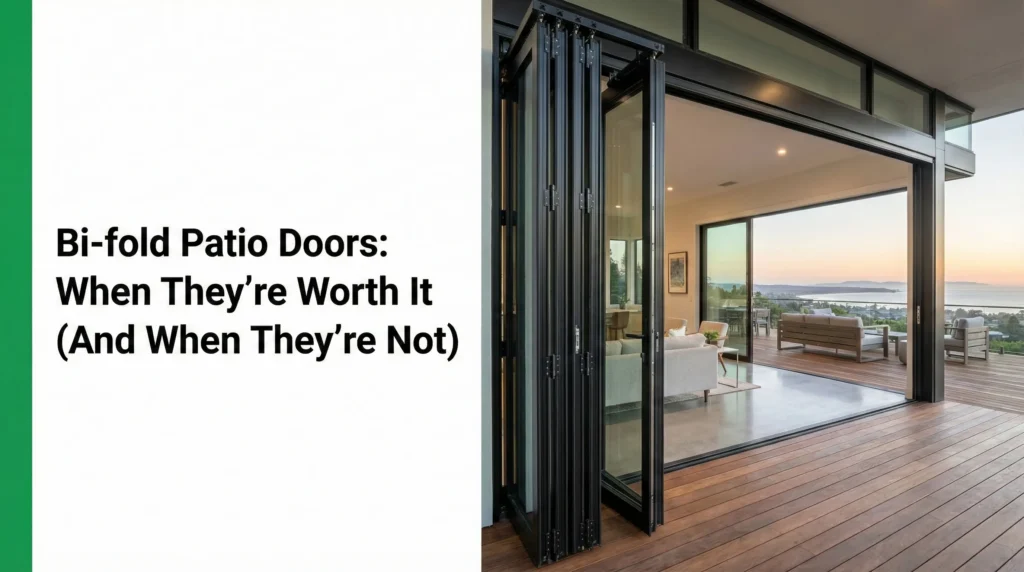
Bi-fold doors consist of multiple glass panels connected by hinges that fold accordion-style along a track system. Unlike sliding doors where panels glide horizontally behind each other, bi-fold panels fold and stack to one or both sides, opening 80-90% of the total opening width.
Key System Components
Track System:
- Top-hung: Panels hang from overhead track; smoother operation, no floor track to trip over or collect debris
- Bottom-rolling: Panels roll on floor track; more stable for very large/heavy systems but creates trip hazard and drainage challenges
Hardware:
- Multi-panel hinges connecting each panel
- Rollers or hangers (depending on track type)
- Multipoint locking system (engages at multiple points when closed)
- Weatherstripping at panel edges and meeting points
Panel Configurations:
| Configuration | Opening Width | Typical Use |
|---|---|---|
| 2-panel | 6-8 ft | Simplest, both fold to one side |
| 3-4 panel | 8-12 ft | Can fold to one side or split (panels fold to both sides) |
| 6+ panel | 16+ ft | Large openings, typically split configuration |
| Traffic door | Any size | One panel operates independently like a standard door (essential for daily use) |
Why This Matters: All these components—hinges, rollers, tracks, weatherstripping at multiple panel joints—make bi-fold systems significantly more complex than sliding doors. More components mean higher initial cost, more potential failure points, and more maintenance over time.
Space Requirements: Bi-Fold vs Sliding Doors
This is where many specification mistakes happen. Bi-fold doors don’t “disappear”—they stack somewhere, and that space must be planned for.
Opening Width Utilization
Bi-fold doors:
- Clear opening: 80-90%+ of total width when fully open
- Example: 16-foot opening = ~14 feet clear width
- Best for: Large openings (12+ feet) where maximizing clear width matters—entertaining spaces, indoor-outdoor dining, commercial patios
Sliding doors:
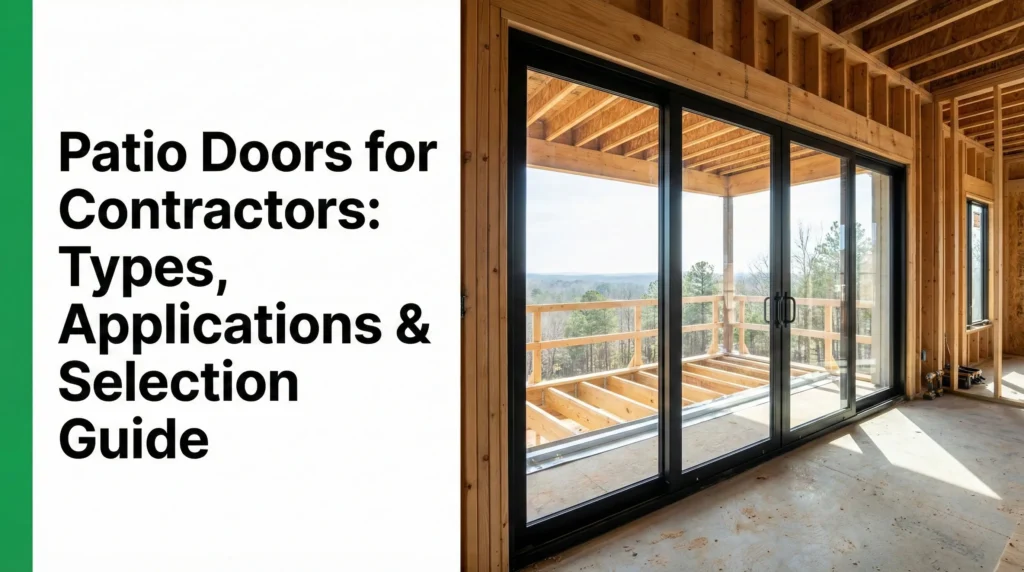
- Clear opening: 50% of total width (one panel slides behind the fixed panel)
- Example: 16-foot opening = 8 feet clear width
- Best for: Standard residential applications where 50% opening adequate
Decision Point: If the project doesn’t need more than 50% opening width, sliding doors deliver the same functional benefit at 1/3 the cost. Bi-fold’s advantage only materializes when the full wall needs to open.
Stack Space Requirements
Bi-fold doors require stack space where folded panels sit:
- 2-panel system: Stacks ~6-8 inches deep on one side
- 4-panel system: Stacks ~12-16 inches deep (two panels on each side if split, or all on one side)
- 6-panel system: Stacks ~18-24 inches deep
Stack space impacts:
- Interior: Stacked panels occupy floor space, limit furniture placement, may block adjacent windows
- Exterior: Stacked panels occupy patio space, may interfere with outdoor furniture or landscaping
Sliding doors:
- No stack space needed—panels remain on same plane when open
- No furniture placement restrictions
Common Mistake: Specifying bi-fold without verifying adequate stack space, then discovering stacked panels block views, windows, or usable patio area.
Contractor Planning Tip: Walk the space (or review floor plans carefully) to confirm stack locations work with interior layout and outdoor furniture plans before ordering bi-fold systems.
Structural Requirements
Bi-fold systems are heavy:
- Typical 4-panel system: 480-600 lbs total weight
- 6-panel system: 700-900+ lbs
Header/lintel requirements:
- Must support full system weight plus deflection limits (bi-fold tracks require minimal deflection—sagging headers cause binding panels)
- Top-hung systems: All weight on overhead track—more demanding header requirements
- Bottom-rolling: Weight distributed to floor, but still requires rigid header to prevent track misalignment
Sliding doors:
- Same total weight but distributed differently (panels don’t hang or fold)
- More forgiving of minor structural movement
Implication for Projects: Renovation projects may require header reinforcement to accommodate bi-fold systems. New construction can plan for this, but retrofit projects face added structural costs.
Cost Considerations: When the Premium Is (and Isn’t) Justified
System Cost Comparison
Bi-fold patio doors:
- Material cost: $1,500-$3,500 per linear foot (depending on frame material, glass options, hardware grade)
- Typical 10-foot opening: $10,000-$30,000+ for complete system
- Premium systems (wood-clad, commercial-grade hardware, high-performance glass): $3,000-$5,000+ per linear foot
Sliding patio doors:
- Material cost: $500-$1,500 per linear foot
- Typical 10-foot opening: $4,000-$12,000 for complete system
Cost ratio: Bi-fold typically 2-3x the cost of sliding for same opening width
Installation Cost
Bi-fold installation:
- Labor cost: $25-$40 per square foot (higher due to alignment complexity, multi-panel coordination, hardware installation)
- Time: 1.5-2x longer than sliding door installation
- Skill requirement: Experienced installers essential—misalignment causes binding, poor weathersealing, operational issues
Sliding installation:
- Labor cost: $15-$30 per square foot
- Time: Faster, more standardized process
- Skill requirement: Standard door installation skills adequate
Lifecycle Cost: Energy Performance & Maintenance
Energy Performance:
Bi-fold doors have more sealing challenges due to multiple panel joints:
- Typical U-factor: 0.35-0.45 (more heat loss/gain than sliding)
- Air infiltration: 2-3x higher than quality sliding systems
- Best for: Mild climates where doors opened frequently; less suitable for extreme cold/heat
Sliding doors typically offer better thermal performance:
- Typical U-factor: 0.28-0.35 (better insulation)
- Air infiltration: Lower due to fewer sealing points
- Best for: Climate extremes, year-round comfort priority
Maintenance:
Bi-fold systems require more maintenance:
- Multiple hinges, rollers, and locking points to service
- Track must stay clean and aligned (debris causes binding)
- Weatherstripping at multiple panel edges degrades faster
- Annual maintenance recommended for commercial or high-use applications
Sliding systems have simpler maintenance:
- Fewer moving parts (2-4 rollers vs 12+ hinges/rollers in bi-fold)
- Track cleaning easier (linear track vs folding track)
- Less frequent service needs
Cost-Benefit Decision Framework
| When Bi-fold Doors Justify Cost | When Sliding Doors Are Smarter Choice |
|---|---|
| ✅ Opening width >12 feet AND need for 80%+ clear opening (full wall opens) | ✅ Standard residential opening (6-10 feet) where 50% opening adequate |
| ✅ High-end residential or commercial hospitality where aesthetics and experience drive ROI | ✅ Multi-unit residential where cost control and standardization critical |
| ✅ Mild climate with frequent indoor-outdoor use (Southern California, Florida, Hawaii) | ✅ Extreme climates (very hot/cold) where thermal performance priority |
| ✅ Budget explicitly accommodates 2-3x premium over sliding doors | ✅ Budget-conscious projects where cost-per-function matters |
| ✅ Client specifically wants the dramatic “wall disappears” effect | ✅ Minimal maintenance preference (property management, vacation rentals) |
For more detailed comparison: See our complete bi-fold vs sliding doors analysis.
Best Applications: When Bi-Fold Doors Are Worth It
Custom Luxury Homes
Why bi-fold works here:
- Living room or master bedroom to large patio/deck (12-20+ foot openings)
- Homeowner values “seamless indoor-outdoor flow” and willing to pay premium
- Budget accommodates $15,000-$40,000+ for door system
- Architect/designer specifies bi-fold as key design feature
Configuration recommendations:
- 4-6 panel systems most common for residential
- Split configuration (panels fold to both sides) balances stack space
- Always include traffic door for daily use without opening full system
Commercial Hospitality
Ideal applications:
- Restaurants opening to patio dining (maximize connection, increase usable space)
- Hotel lobbies to courtyard or pool areas
- Cafes and bars (indoor-outdoor serving areas)
Why bi-fold works:
- Operational revenue tied to opening capability (more patio seating = more covers)
- “Wow factor” attracts customers and supports premium pricing
- Commercial projects can absorb higher cost and maintenance
Requirements:
- Commercial-grade hardware and rollers (higher cycle rating for daily operation)
- Aluminum frames (durability, slim sightlines, low maintenance)
- Impact-rated or laminated glass (code requirements, security)
Mild/Coastal Climates
Where bi-fold systems perform best:
- Southern California, Florida, Hawaii, coastal regions with mild year-round weather
- Doors open frequently (spring, summer, fall)—thermal performance less critical
- Indoor-outdoor lifestyle justifies investment
Why climate matters:
- Bi-fold’s thermal performance disadvantage minimized when doors open often
- Less stress on weatherstripping in mild climates (no freeze/thaw cycles)
- Lower heating/cooling loads reduce energy penalty
Large Openings (12+ Feet)
Bi-fold’s strongest use case:
- 12-20+ foot openings where sliding doors only provide 6-10 feet clear width
- Bi-fold delivers 10-18+ feet clear width—transformative difference
- Examples: Great room to pool deck, entire wall opening to backyard
Why size matters:
- Below 10 feet: Bi-fold overkill—sliding adequate and more cost-effective
- 10-12 feet: Toss-up—depends on budget and priorities
- 12+ feet: Bi-fold’s clear opening advantage becomes significant
When Bi-Fold Doors DON’T Make Sense
Multi-Unit Residential (Apartments, Condos)
Why bi-fold rarely works for multi-unit:
- ❌ Cost prohibitive for bulk orders: 2-3x sliding cost erodes project margins
- ❌ Higher maintenance burden: Property management faces more service calls, higher ongoing costs
- ❌ Security concerns: Ground-floor units—multiple locking points more vulnerable than sliding
- ❌ Typical balcony sizes too small: 6-8 foot openings don’t benefit from bi-fold’s advantages
- ❌ Standardization challenges: Harder to standardize across units (more variables, custom configurations)
Rare exceptions where bi-fold works in multi-unit:
- Luxury penthouse units (premium pricing justifies premium doors)
- Ground-floor units with private courtyards (marketing differentiator)
- Clubhouse/amenity spaces (not individual units)
General rule: For 95%+ of multi-unit applications, sliding doors deliver better value, lower risk, and easier property management.
Small Openings (< 10 Feet)
Why bi-fold doesn’t make sense:
- 8-foot opening with bi-fold: ~7 feet clear width
- 8-foot sliding door: 4 feet clear width
- Benefit: Only 3 feet more clear width for 2-3x cost and added complexity
Better alternatives:
- Standard sliding door: Adequate function, 1/3 the cost
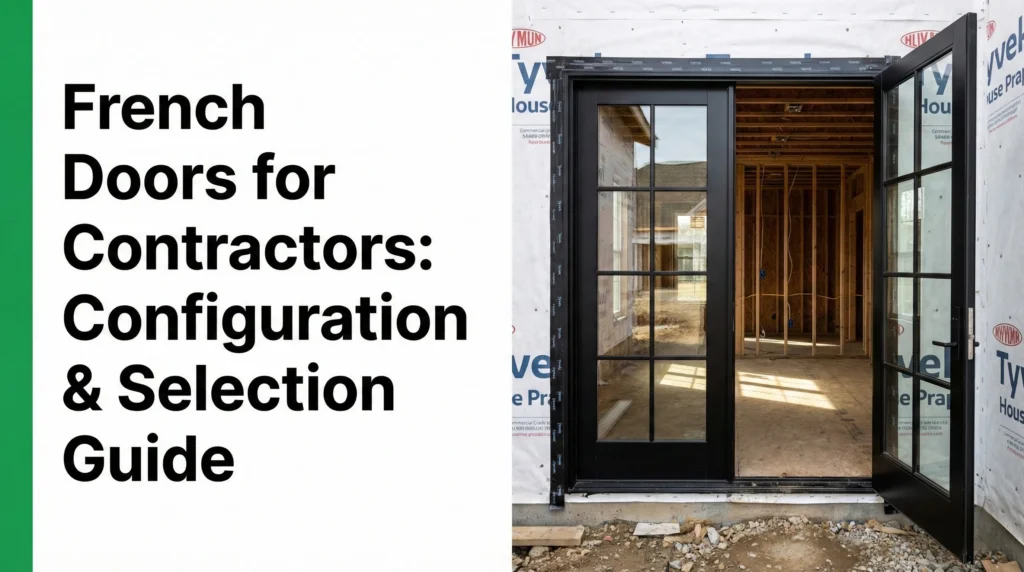
- French doors: If full opening desired, similar cost to bi-fold but simpler hardware
Contractor recommendation: Don’t specify bi-fold for openings under 10 feet unless client explicitly wants it for aesthetic reasons and understands the cost premium.
Extreme Climates (Very Hot or Very Cold)
Thermal performance challenges:
- Multiple panel sealing points allow more air infiltration
- Energy loss higher than quality sliding systems
- Comfort issues in extreme weather (drafts, temperature fluctuations)
Better choice for extreme climates:
- High-performance sliding doors with multi-chamber frames and triple glazing
- Lift-and-slide systems (European-style) for tighter seals
- French doors with quality weatherstripping
Exception: If client insists on bi-fold in extreme climate, specify premium thermal package: thermal breaks, triple-pane Low-E glass, compression weatherstripping at all panel joints.
Budget-Conscious Projects
Simple math:
- Bi-fold: $15,000-$30,000 for typical opening
- Sliding: $5,000-$10,000 for same opening
- Savings: $10,000-$20,000+ that could go toward other finishes, landscaping, or builder profit
When to recommend sliding instead:
- Spec homes where cost control affects margins
- First-time homebuyers (won’t pay premium for bi-fold)
- Investment properties (rental income doesn’t justify luxury door systems)
- Any project where $10,000-$20,000 savings matters more than “wall disappearing” effect
Common Specification Mistakes to Avoid
1. Not Planning for Stack Space
The mistake: Assuming folded panels “disappear” without checking where they actually stack.
The consequence: Stacked panels block adjacent windows, conflict with furniture placement, or occupy too much patio space.
The fix: Review floor plans to verify stack locations work with room layout. Consider split configuration (panels fold to both sides) to minimize stack depth on each side.
2. Specifying Bi-Fold for Small Openings
The mistake: Using bi-fold for 6-8 foot openings because “client wants bi-fold doors.”
The consequence: Marginal functional benefit (only 2-3 feet more clear width than sliding) for 2-3x cost and complexity.
The fix: Educate client on cost-benefit trade-off. If under 10 feet, recommend sliding or French doors unless budget explicitly supports the premium.
3. Forgetting the Traffic Door
The mistake: Specifying all panels to lock together with no independently operating panel.
The consequence: Homeowner must open 3-4 panels every time they step outside—inconvenient and accelerates wear on full system.
The fix: Always include traffic door (one end panel operates independently) for residential applications. Only skip for commercial installations where full opening always used.
4. Underestimating Structural Requirements
The mistake: Treating bi-fold installation like sliding door installation (similar opening size).
The consequence: Inadequate header support causes track deflection—panels bind, don’t seal properly, operation becomes difficult within 1-2 years.
The fix: Verify structural capacity for top-hung systems (all weight on header) or ensure rigid framing for bottom-rolling systems. Retrofit projects may need structural reinforcement.
5. Low-Budget Hardware on High-End Doors
The mistake: Choosing lower-grade rollers, hinges, or locks to reduce cost.
The consequence: Components fail prematurely—binding panels, difficult operation, security issues. Replacement parts expensive and labor-intensive.
The fix: Bi-fold systems already expensive—don’t compromise on hardware quality. Commercial-grade components for any high-use or commercial application. Budget for quality from the start.
Material & Performance Options
Frame Materials
Aluminum:
- Best for: Commercial projects, coastal areas, modern aesthetics, large panel sizes
- Pros: Strength (supports large glass panels), corrosion resistance, slim profiles (more glass area), low maintenance
- Cons: Requires thermal breaks for energy efficiency in extreme climates
- Note: Most common choice for bi-fold systems
Wood-Clad:
- Best for: Custom luxury homes, traditional or transitional styles
- Pros: Premium aesthetic, interior wood finish options, exterior aluminum cladding protects wood from weather
- Cons: Higher cost (30-50% premium over aluminum), more maintenance (interior wood surfaces)
Vinyl:
- Rarely used for bi-fold due to insufficient strength for large glass panels and multiple hinges
- Better suited for sliding or casement applications
Composite/Fiberglass:
- Best for: Extreme climates, coastal environments, low-maintenance priority
- Pros: Superior durability, dimensionally stable (won’t warp/expand), can mimic wood appearance
- Cons: Higher cost than aluminum, less common (longer lead times)
Glass & Energy Options
Standard configuration:
- Double-pane Low-E insulated glass
- Tempered for safety (code required)
- Argon gas fill between panes
Upgrade options for specific needs:
- Triple-pane glass: Extreme climates, higher thermal performance (but adds weight and cost)
- Laminated glass: Security (holds together when broken), sound reduction, commercial applications
- Low SHGC glass: Hot climates (blocks solar heat gain)
- Higher SHGC glass: Cold climates (passive solar heat beneficial)
Lead Time & Project Planning
Typical lead times:
- Custom bi-fold systems: 8-10 weeks from order to delivery
- Bulk orders (multiple units): May extend to 10-12 weeks depending on quantity
- Note: Longer than sliding doors due to hardware complexity and custom configurations
Project coordination:
- Structural requirements verified before ordering (header capacity, floor level)
- Installation typically requires 1-2 days per opening (vs half-day for sliding)
- Must coordinate with other trades (electrical for motorized options, drainage for floor tracks)
For custom projects: Confirm configuration, panel count, swing direction, and stack locations with client before placing order—changes after manufacturing starts expensive or impossible.
Conclusion: Making the Right Choice for Your Project
Bi-fold patio doors deliver impressive aesthetics and functionality—when applied to the right projects. But they’re not a universal solution.
Bi-fold doors make sense when:
- Opening width 12+ feet where maximizing clear opening matters
- Budget accommodates 2-3x premium over sliding doors
- Indoor-outdoor entertaining is project priority
- Custom luxury home or commercial hospitality application
- Mild climate with frequent door operation
Sliding doors are the smarter choice when:
- Standard residential opening (6-10 feet)
- Multi-unit projects requiring cost control
- Extreme climates where thermal performance critical
- Budget-conscious projects
- Lower maintenance preference
The key decision isn’t “bi-fold vs sliding” in abstract—it’s whether the specific project’s requirements, budget, and use case justify bi-fold’s premium cost and complexity.
Need help determining the right door system for your project?
Hotian works with contractors and builders to specify door systems that match project requirements and budgets. We support bulk bi-fold orders (10+ units) with:
- Free structural assessment and installation guidance
- 8-10 week delivery on custom configurations
- Vinyl, aluminum, wood-clad, and composite material options
- Commercial-grade hardware for high-cycle applications
Resources for project planning:
- Download our Bifold Door Sizing Chart with standard and custom dimensions
- Review our complete patio door options for alternative solutions
- Read our detailed patio door buying guide for specification best practices
Contact us early in the design process—custom bi-fold systems require 8-10 weeks lead time, so early coordination keeps projects on schedule.