Whether you’re replacing a broken part or upgrading your door hardware, choosing the right latch can be confusing.
This guide demystifies every common latch type with clear visuals, measurements, and decision tips so you can identify and select the exact part you need—fast.
Latch vs. Lock: What’s the Difference?
A latch keeps the door closed with a spring‑loaded bolt; a lock secures the door against entry (often a separate deadbolt).
Latch: a spring-loaded, angled bolt held in by a knob/lever’s return spring. It “clicks” into the strike to keep the door shut.
Lock: a security device (e.g., deadbolt) that cannot be retracted without a key/turn. Entry doors usually use both a latch (with a deadlatch feature) and a separate deadbolt.
Further Reading:
- For the frame side of this system, see Door Frame Types and Door Sill vs. Threshold.
What Measurements Do You Need Before Buying a Latch?
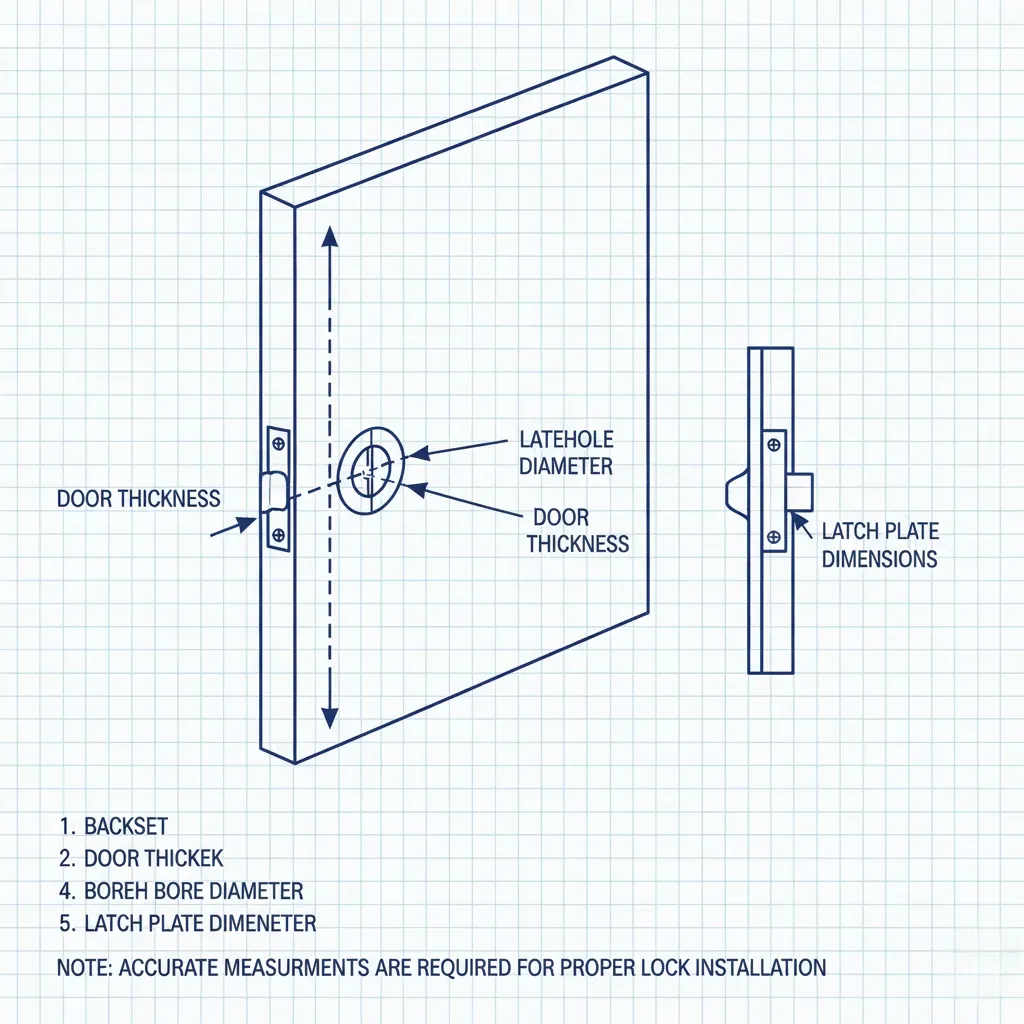
Measure three things—backset, door thickness, and bore hole diameter. These determine fit more than the latch “type” alone.
1) Backset (most important)
- What it is: Distance from the door edge to the center of the knob/lever bore.
- Standards: 2‑3/8″ (60 mm) or 2‑3/4″ (70 mm). Many modern latches are adjustable.
- How to measure: From the edge of the door to the center of the large bore (or spindle).
2) Door Thickness
- Common sizes: 1‑3/8″ (interior) and 1‑3/4″ (exterior). Others exist for specialty doors.
- Why it matters: Determines spindle length, latch body depth, and faceplate fit.
3) Bore Hole Diameter
- Common size: 2‑1/8″ for the main bore; 1″ for the edge bore (latch face).
- Why it matters: Ensures the latch body and faceplate sit correctly.
Pro tip:
- Also note faceplate style (drive‑in vs. faceplate) and faceplate size (often 1″ × 2‑1/4″) to ensure a clean retrofit.
Which Latch Do I Have? Identification by Installation & Faceplate
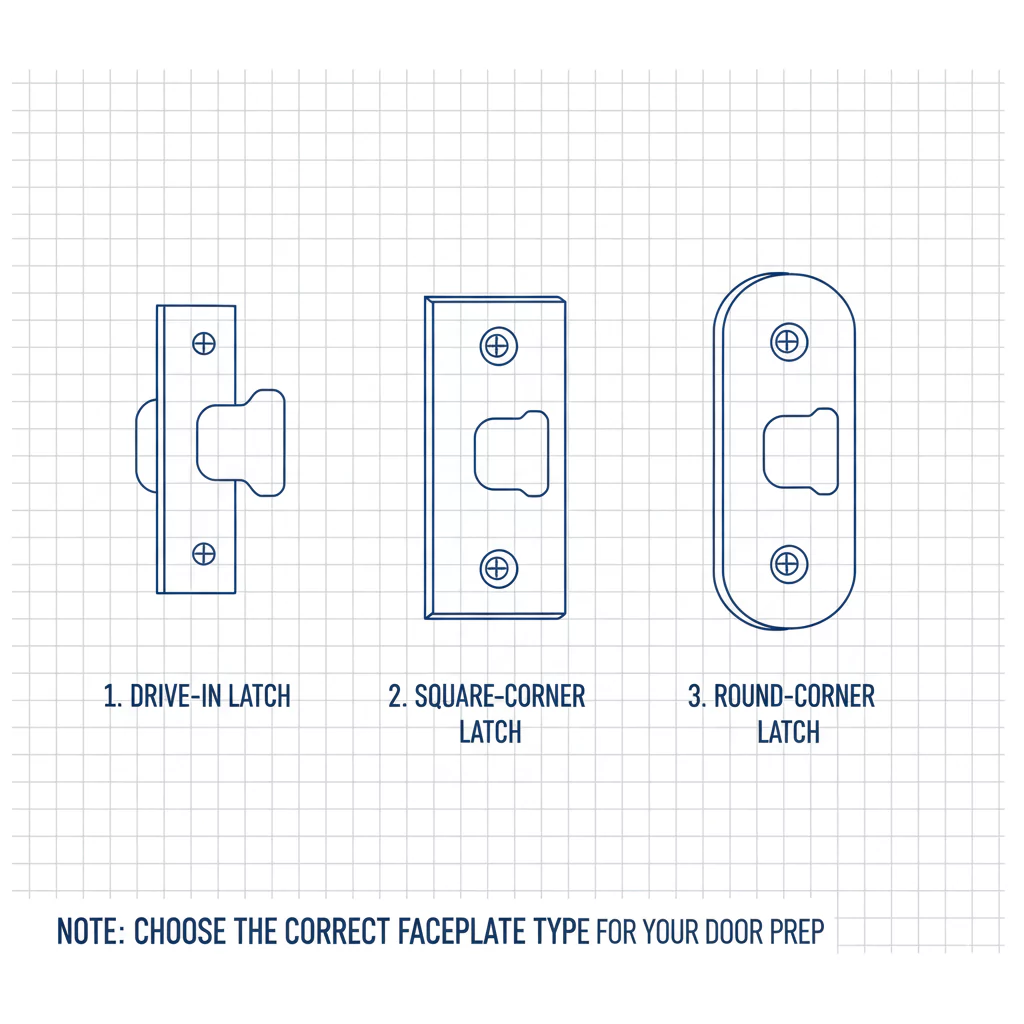
Latches mount either as a round “drive‑in” body or with a rectangular faceplate (square or rounded corners). Matching the faceplate style to your existing door edge mortise is critical.
Drive‑In Latch
- Description: Round collar pressed/hammered into a 1″ edge bore; no rectangular faceplate.
- Best for: Pre‑bored doors without a rectangular mortise; quick retrofits.
- Watch for: Requires a snug 1″ edge bore and proper alignment with the strike.
Faceplate Latches (Rectangular Plate)
- Square‑Corner Faceplate
- The square-corner faceplate has sharp 90° corners and fits a chisel-cut mortise.
- Rounded‑Corner Faceplate
- Radiused corners fit a router-cut mortise (fast production milling).
- This faceplate is ideal for traditional installations and provides a flush, reinforced edge fit.
- Watch for: Match the plate size (commonly ~1″ × 2‑1/4″) and corner style to your existing mortise.
Comparison table:
| Install Type | What It Looks Like | Pros | Cons | Retrofit Notes |
|---|---|---|---|---|
| Drive‑In | Round collar, no plate | Fast, minimal chiseling | Less bearing surface | Needs accurate 1″ bore |
| Square‑Corner Plate | Rectangular, sharp corners | Strong, classic fit | Requires chiseling | Matches chisel mortise |
| Round‑Corner Plate | Rectangular with radiused corners | Router‑friendly, clean | Plate size must match | Matches routed mortise |
How Do Different Door Latch Mechanisms Work?
Most interior doors use a spring latch; entry sets should use a deadlatch. Mortise latches are box‑type assemblies, and magnetic latches offer silent modern operation.
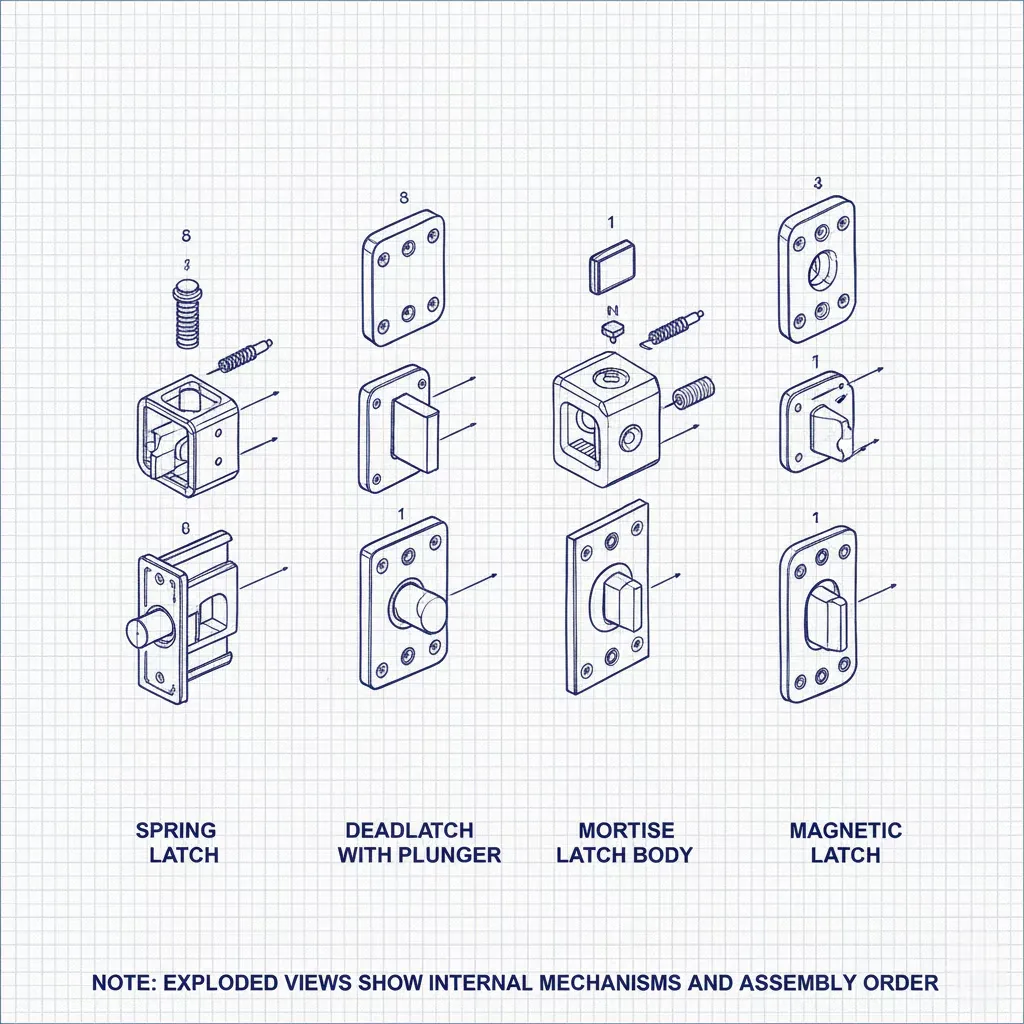
Spring Latch
- What it is: Standard angled latch for passage/privacy sets; retracts with handle.
- Use: Interior hall/closet (passage) and bed/bath (privacy with push‑pin/turn).
Deadlatch (Deadlocking Latch)
- What it is: Spring latch with a small side plunger. The strike depresses the plunger when the door closes, thereby preventing credit card bypass.
- Use: Any keyed entry knob/lever; improves security on latch sets.
Mortise Latch
- What it is: A large rectangular box installed into a deep door pocket; it often integrates a latch and deadbolt with a single trim set.
- Use: This latch is suitable for older homes, premium residential properties, and commercial doors; it requires precise mortising.
Magnetic Latch
- What it is: Uses magnets to hold the door shut; no angled latch “tongue.”
- Use: Modern interiors needing quiet, soft closure, and clean aesthetics.
Mechanism matrix:
| Mechanism | Security | Noise | Install Complexity | Typical Application |
|---|---|---|---|---|
| Spring Latch | Low | Medium “click” | Low | Interior passage/privacy |
| Deadlatch | Medium | Medium | Low | Residential entry with keyset |
| Mortise Latch | Medium–High | Medium | High | Premium/legacy doors |
| Magnetic Latch | Low–Medium | Very Low | Medium | Modern interior, quiet close |
Related Reading:
- For door build types that influence hardware choice, see Flush Door vs. Panel Door and Aluminum vs. Vinyl Doors.
Which Latch Do You Need by Application?
Match function to room and security. Passage/privacy latches inside; deadlatch on entries; specialty surface latches for gates/sheds; roller/ball catches for cabinet/closet doors without knobs.
Interior Latches
- Passage: No lock function; spring latch only.
- Privacy: Bed/bath with inside pin/turn; emergency release outside.
Exterior Latches
- Entry doorknob/lever: Should use a deadlatch at minimum.
- Add a separate deadbolt for true security.
Gate & Shed Latches
- Types: Surface‑mounted thumb latches, ring latches, and barrel/slide bolts.
- Notes: Weather‑rated materials (galvanized/stainless).
Cabinet & Closet Latches
- Types: Roller catch, ball catch, magnetic catch.
- Use: Hold doors closed without a conventional knob/lever.
Related reading:
- Weather sealing the frame improves latch performance—see How to Install Door Weatherstripping and How to Replace a Door Threshold.
Troubleshooting: How Do You Match the Latch to Your Problem?
Please identify the symptom, inspect the strike alignment and latch type, and then upgrade or adjust as needed.
- The door swings open on its own
- Likely causes: weak spring latch, strike misalignment, loose hinges.
- Fix: Adjust strike depth/position; tighten hinges; consider a stronger latch or a ball catch for closet pairs.
- Bonus fix: Reduce squeaks for a clean close—see How to Make a Door Stop Squeaking.
- The entry door can be pushed open easily
- Likely cause: a simple spring latch without a deadlocking function or a strike not depressing the deadlatch plunger.
- Fix: Upgrade to a deadlatch; adjust the strike so the small plunger is fully depressed.
- Want silent, “no click” closure
- Solution: Magnetic latch or quality roller catch with soft engagement.
- The latch won’t reach the strike
- Check for backset mismatch (2‑3/8″ vs 2‑3/4″), door sag, or warped frame.
- Fix: Use the correct backset latch; rehang/shim; for exterior, review sill/threshold.
- Upgrading patio or glass doors
- Consider the door style—see Patio Door Types and Styles of Glass Doors.
Quick Selector: Latch Type by Scenario
- Interior bedroom/bath: Privacy spring latch (with emergency release).
- Interior hall/closet: Passage spring latch.
- Front/side/back entry: Deadlatch plus separate deadbolt.
- Historic/commercial: Mortise lockset compatible latch/bolt.
- Ultra‑quiet interior: Magnetic latch.
- Gate/shed: Surface‑mount latch or bolt in stainless/galvanized.