While the door receives the majority of attention, the frame plays a crucial role in ensuring it hangs straight, seals tightly, and endures for decades.
This guide demystifies door frames—by anatomy, material, construction, and application—so you can choose the perfect frame for your home with confidence.
What Are the Parts of a Door Frame? (Anatomy & Diagram)
A door frame is a three-sided structure—a head jamb, two side jambs, and (for exteriors) a sill—with a threshold cap, door stops, and decorative casing to finish and seal the opening.
- Head Jamb: The top horizontal member.
- Side Jambs: The two vertical members on either side.
- Sill: The bottom horizontal component for exterior frames that sheds water.
- Threshold: The protective cap atop the sill—what you step over; interfaces with sweeps.
- Door Stop: A thin strip on the inside of the frame that the door closes against for a seal.
- Casing: Decorative trim that hides the gap between the frame and the wall.
For related basics, refer to our primer, “Door Parts Names,” as well as the sections on bottom sealing in “How to Replace a Door Threshold” and “How to Install Door Weatherstripping.”
Which Door Frame Material Is Best? (Head‑to‑Head Comparison)
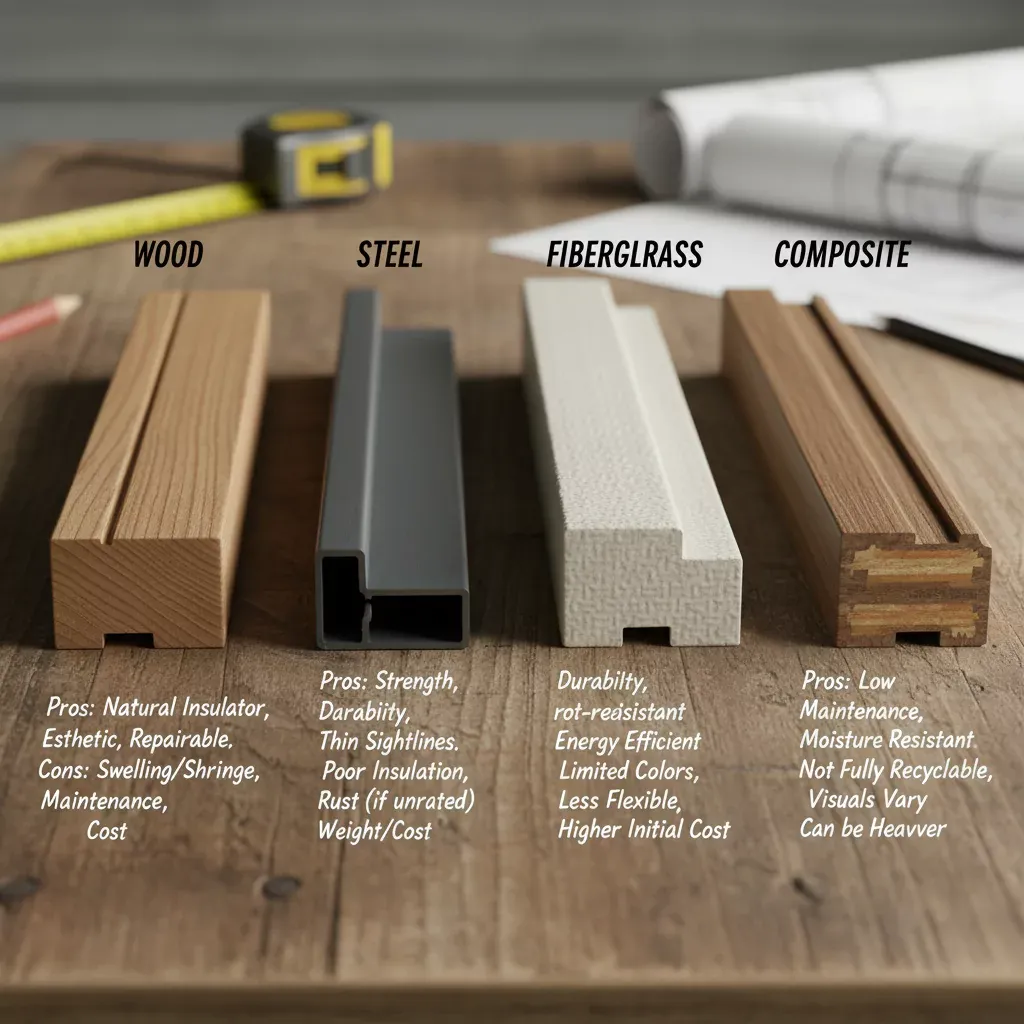
Choose material by location (interior vs. exterior), exposure (moisture, sun), desired look, and maintenance. Wood is classic indoors; fiberglass/composite excels outdoors; steel wins on strength.
| Material | Pros | Cons | Best For |
|---|---|---|---|
| Wood | Classic look; stain/paint friendly; strong and easy to mill | Can rot/warp outdoors; periodic maintenance; pricier hardwoods | Interiors, historic homes, stained or high‑end entries |
| Steel | Extremely strong; secure, and fire‑rated options available | Can dent; may rust if coating is breached; industrial look | Exterior security doors: commercial; basements/utility |
| Fiberglass | Won’t rot, rust, or warp; low maintenance; stable | Higher upfront cost; fewer traditional profiles | Harsh/wet climates; coastal; exterior entries |
| Composite (e.g., PVC/WPC/LVL) | Rot-proof; paint holds well; durable and dimensionally stable | Heavier; often pricier than wood | Exterior frames where wood would fail; long‑term durability |
Notes:
- For exteriors, prioritize moisture resistance and thermal stability.
- For interiors, aesthetics and easy carpentry often favor wood.
Information gain:
- For hurricane/impact zones, pair fiberglass or composite frames with impact‑rated doors and hardware; check local code and wind zone requirements.
- In termite‑prone regions, avoid untreated wood frames at exteriors or specify treated sill/jamb bottoms.
What’s the Difference Between Pre‑Hung and Knock‑Down Frames?
Pre‑hung units arrive with the door already hinged in a 3‑sided frame—fast for most installs. Knock‑down (KD) frames and slab‑only doors separate the parts and demand more carpentry skill.
Pre‑Hung Door Frames
- What it is: A door pre‑mounted on hinges inside a complete frame (head + side jambs), usually with a pre‑drilled latch/lock, integrated stops, and for exteriors, a sill/threshold and weatherstrip.
- Best for: New construction, full replacements, and most DIYers—the easiest path to a square, plumb, properly gapped door.
Pros:
- Factory alignment, faster installation, consistent reveals, and included weatherstripping (exterior).
Cons: - Heavier to handle; requires correct rough opening; can disturb finished trim/flooring during replacement.
Knock‑Down (KD) or “Slab” Frames
- What it is: Frame members are sold separately and assembled on-site; a “slab door” is just the door leaf with no frame or hardware.
- Best for: Custom openings, retrofits where you’ll keep a sound existing frame, or advanced carpentry where you’ll mortise hinges and set reveals manually.
Pros:
- Flexible for out‑of‑square openings, easier to transport, and precisely custom fit.
Cons: - Slower; higher skill; more tools (chisels/router for hinges, bore kit for locks).
Clarity note:
- “Slab” refers to the door panel itself. You can pair a slab with an existing frame if it is solid or assemble a KD frame to suit.
Which Specialty Door Frame Fits Your Application?
Sliding or folding doors need purpose‑built frames and tracks; glazed units with sidelights/transoms are integrated systems that demand precise sizing.
- Pocket Door Frames: Metal/wood “cassette” inside the wall; door slides into the cavity. Ideal where swing space is tight. Requires straight, plumb framing and proper wall thickness.
- Barn Door Frames: Typically no jambs—just a reinforced header and exposed track/hardware above the opening. Great for rustic/modern looks; limited acoustic/privacy seal.
- Bifold Door Frames: Simple opening with top track and pivots; common for closets. Mind clearances and hardware alignment.
- Frames with Sidelights/Transoms: Door and glazed panels integrated into one frame. Adds light and curb appeal; increases weight and structural, flashing, and waterproofing needs.
Pro tips:
- Use soft‑close pocket/barn kits for smoother operation.
- In wet areas (entries), specify composite/fiberglass frames with integral sills and proper pan flashing.
Explore styles next: French Doors vs. Sliding Doors vs. Patio Doors: Cost Comparison.
How Do You Choose the Right Door Frame? (4 Key Questions)
Please consider factors such as location, budget, installation approach, and what you are replacing.
- Interior or Exterior?
- Exterior frames must be able to withstand weather conditions; therefore, choose materials such as fiberglass, composite, or treated wood, and ensure that they include a sill, threshold, and weatherstripping. Interior frames can be wood without sills.
- What’s Your Budget?
- Steel can be economical; wood/composite sits in the mid‑range; fiberglass is often premium but low‑maintenance. Consider lifetime costs, not just purchase price.
- DIY or Hiring a Pro?
- DIY: pre-hung is easiest.
- Custom sizes/out‑of‑square walls: consider a pro (they’ll shim, plane, and tune for perfect reveals and latch alignment).
- What Are You Replacing?
- Solid, square frame: a new slab may suffice.
- Rot, rust, or damage: replace with a full pre-hung unit. Inspect the sill and subfloor for moisture issues before reinstalling.
Related fixes:
- Tighten seals with How to Install Door Weatherstripping.
- Resolve bottom drafts with How to Replace a Door Threshold.
- Diagnose hardware fit in Door Latch Types.
What Size Rough Opening Do You Need? (Rough Opening vs Frame Size)
The rough opening is the stud‑to‑stud hole; the frame is slightly smaller so you can shim it plumb and level. Rule of thumb: the rough opening is typically 2 in wider and 2 in taller than the door size.
- Simple rule: RO width≈door width+2 inRO width≈door width+2 in; RO height≈door height+2 in RO height ≈ door height + 2 in.
- Pre-hung interiors: Many manufacturers spec +2 in (W) × +2 in (H), but always verify the product sheet.
- Exteriors: Allow for sill/threshold height and floor transitions; some units need +2 to +2.5 in height.
Common examples (nominal):
- 30×80 in door → RO ~ 32×82 in
- 32×80 in door → RO ~ 34×82 in
- 36×80 in door → RO ~ 38×82 in
Caution:
- Walls out of plumb? Add a bit more tolerance to the width and rely on shims for perfect reveals.
- Match the hinge handling and swing to the space.
More sizes here: Average Door Sizes.
Conclusion: The Foundation of Every Great Door
The right frame balances material, construction method, and application with your budget and skill level. Select moisture-resistant frames for external applications, prehung frames for simple installation, and specialty frames for applications requiring sliding, folding, or glazed units.
Next step: explore styles and performance choices—start with Solid Core vs Hollow Core Doors. Keep doors smooth and healthy with How to Make a Door Stop Squeaking, Winter Door Swelling Fix, and How to Clean and Prevent Mold on Doors.