Modern homes face a common challenge: maximizing usable space while maintaining style and functionality. Traditional swing doors require significant clearance—up to 9 square feet of floor space per door—making them impractical for compact layouts, open floor plans, and space-conscious designs.
Enter two elegant solutions: pocket doors and barn doors.
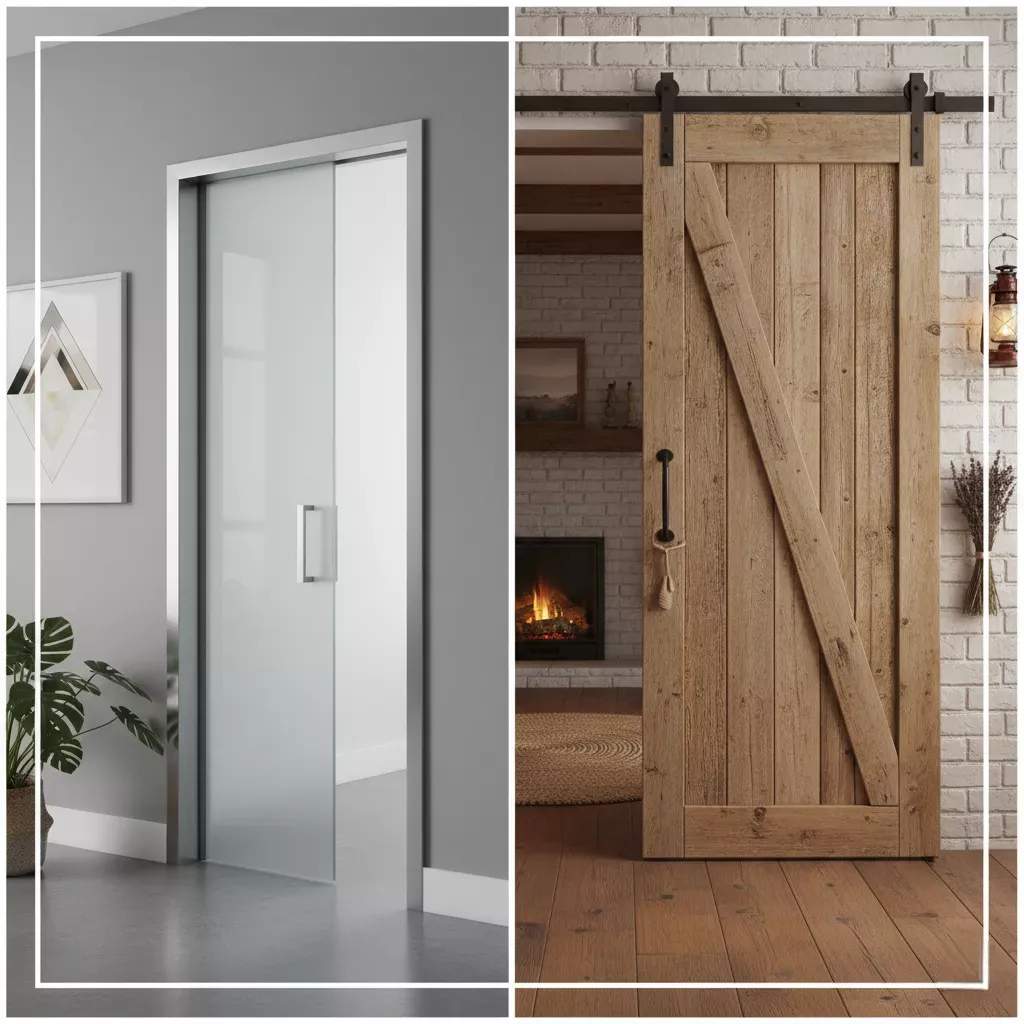
What is a pocket door? A pocket door is a sliding door that disappears completely into a wall cavity when opened, leaving both the doorway and adjacent wall space entirely clear.
What is a barn door? A barn door (also called a sliding barn door or bypass door) slides along a track mounted on the exterior face of a wall, remaining visible when open and creating a bold architectural statement.
Both eliminate the swing radius problem, but they accomplish this in fundamentally different ways—with distinct implications for your budget, installation complexity, privacy needs, and home aesthetics.
This comprehensive guide compares pocket doors and barn doors across every critical dimension: space efficiency, installation requirements, cost, privacy, maintenance, aesthetics, and ideal use cases. By the end, you’ll know exactly which sliding door solution fits your specific needs.
For broader door style comparisons, see Modern vs. Traditional Door Designs.
At a Glance: Pocket Door vs. Barn Door Decision Matrix
Pocket doors offer superior space efficiency and privacy but require complex installation. Barn doors provide easier installation and bold aesthetics but need wall clearance and offer limited privacy.
Quick Reference Comparison Table
| Criteria | Pocket Door | Barn Door | Winner |
|---|---|---|---|
| Space Efficiency | Disappears completely into wall; zero floor/wall space | Requires wall space equal to door width | Pocket Door |
| Installation Complexity | Difficult; requires wall cavity modification | Simple, surface-mounted track | Barn Door |
| Material Cost | $100−$ (door + hardware kit) | $200−$1,000 (door + hardware) | Pocket Door |
| Installation Cost | $700−$2,500+ (retrofit higher) | $300−$800 (DIY-friendly) | Barn Door |
| Total Average Cost | $800−$3,000+ | $500−$1,800 | Barn Door |
| Privacy & Soundproofing | Excellent seal; minimal gaps | Poor seal; visible gaps top/bottom/sides | Pocket Door |
| Maintenance Access | Difficult; requires wall opening | Easy; all hardware exposed | Barn Door |
| Aesthetic Impact | Minimalist; hidden when open | Bold focal point; always visible | Depends on style |
| Locking Options | Standard privacy locks available | Limited; specialty locks required | Pocket Door |
| DIY-Friendly | No; professional recommended | Yes; weekend project | Barn Door |
| Best For | Bathrooms, small spaces, minimalist design | Living areas, design statements, rustic/modern styles | Depends on need |
Decision shortcut:
- Choose pocket door if: Space is extremely limited, privacy is critical (bathrooms), you want invisible doors
- Choose barn door if: You have wall clearance, want a design feature, prefer easier installation
What is a Pocket Door? Pros and Cons Explained
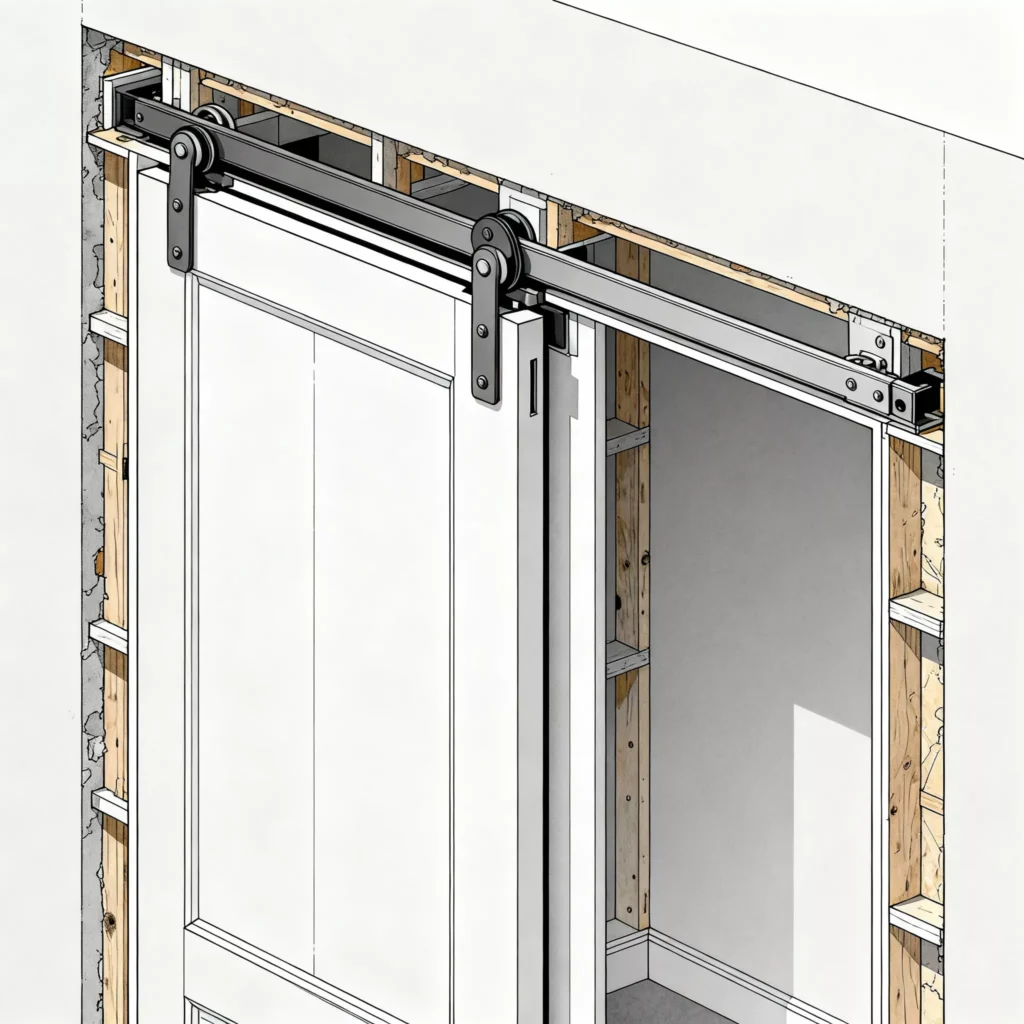
A pocket door is a sliding door that retracts completely into a hollow cavity within the wall, making it invisible when open. It offers maximum space savings and privacy but requires complex installation involving wall modification.
The Advantages of Disappearing: Pocket Door Pros
1. Ultimate Space Saver: Frees Floor and Wall Space
Pocket doors eliminate both the swing radius (floor space) and the door’s visual presence (wall space) when open.
Space savings:
- Swing door requires: 9-12 sq ft clearance (36″ door × 36″ radius)
- Barn door requires: 36″ of clear wall space
- Pocket door requires: Zero floor or wall space when open
Ideal for:
- Narrow hallways and tight corridors
- Small bathrooms (powder rooms, half baths)
- Closets with limited clearance
- Open floor plans where walls are minimal
- ADA-compliant accessibility (no threshold or swing obstruction)
2. Clean and Minimalist Aesthetic
When open, pocket doors completely vanish, creating seamless, uncluttered spaces.
Design benefits:
- Maintains clean sightlines in modern interiors
- Doesn’t interrupt wall space for furniture placement
- Allows for continuous flooring without door swing considerations
- Creates flexible room divisions (open-concept living)
3. Superior Privacy and Soundproofing
Pocket doors seal tightly against all four sides of the frame when closed.
Privacy advantages:
- Minimal light gaps (compared to barn doors with visible gaps)
- Better sound attenuation with proper seals
- Full perimeter weatherstripping possible
- No visible gaps at top, bottom, or sides
Sound ratings: Quality pocket door systems achieve STC (Sound Transmission Class) ratings of 35-45, compared to barn doors at 20-30.
4. Secure Locking Capability
Standard privacy locks, keyed locks, and even electronic locks can be installed.
Security features:
- Flush-mounted privacy locks
- Keyed locks for security
- ADA-compliant hardware available
- No exterior hardware to tamper with
The Hidden Complexities: Pocket Door Cons
1. Difficult and Costly Installation
Installing a pocket door requires significant wall modification.
Installation challenges:
- New construction: Requires pocket door frame kit installed during framing (easier)
- Retrofit: Must open existing wall, remove studs, install frame, patch/finish wall (complex)
- Wall requirements: Need double-wide cavity (2× door width)
- Structural considerations: May require header beam for load-bearing walls
Installation time:
- New construction: 4-6 hours
- Retrofit: 16-24 hours (2-3 days with drywall finishing)
2. Structural and Mechanical Limitations
Not all walls can accommodate pocket doors.
Installation obstacles:
- Plumbing pipes: Cannot install where pipes run vertically
- Electrical wiring: Must reroute or relocate switches/outlets
- HVAC ducts: Ductwork in walls prevents installation
- Load-bearing walls: Require engineered headers
- Exterior walls: Generally unsuitable due to insulation requirements
Wall thickness required: Minimum 6″ (2×6 framing) for most pocket doors; some require 8-10″ for double doors.
3. Maintenance and Repair Challenges
Accessing pocket door hardware requires opening the wall.
Maintenance issues:
- Track adjustments require wall access panels
- Roller replacement needs wall opening
- Difficult to clean track debris
- Door removal often requires disassembly
Common problems:
- Doors derailing from track
- Rollers wearing out (every 10-15 years)
- Track bending or warping
- Door dragging or sticking
Repair costs: 200−200−800 depending on issue severity and wall damage.
4. Limited Door Weight and Size
Pocket door hardware has weight restrictions.
Limitations:
- Maximum door weight: 150-200 lbs (standard hardware)
- Solid wood doors may exceed weight limits
- Large doors (over 42″ wide) may require specialty hardware
- Heavy or decorative doors need reinforced systems
For standard door dimensions, reference Barn Door Sizes.
What is a Barn Door? Pros and Cons Explained
A barn door is a sliding door mounted on an exposed track attached to the wall surface, remaining visible at all times. It offers simple installation and bold aesthetics but requires wall clearance and provides limited privacy due to gaps.

The Appeal of a Feature Piece: Barn Door Pros
1. Aesthetic Focal Point and Design Statement
Barn doors are architectural features that add character and personality.
Design impact:
- Creates rustic, farmhouse, or industrial aesthetic
- Works in modern spaces with sleek hardware
- Available in countless styles: reclaimed wood, glass panel, modern metal
- Hardware becomes decorative element (handles, tracks, rollers)
Popular styles:
- Rustic/Farmhouse: Reclaimed wood with X-bracing, black iron hardware
- Modern: Flush panels with minimalist aluminum tracks
- Industrial: Metal and glass with exposed steel hardware
- Contemporary: Horizontal slat or clean-lined designs
Explore trending options: Are Barn Doors Out of Style in 2025?
2. Simple and DIY-Friendly Installation
Barn doors mount to the wall surface without structural modification.
Installation advantages:
- No wall cavity required
- Standard tools and weekend DIY projects
- Track mounts directly to wall studs or header board
- Easily reversible if you change your mind
- Can be installed by one person in 3-4 hours
Installation requirements:
- Header board mounted to wall studs (for support)
- Level surface for track mounting
- Minimum wall height clearance (door height + 6-8″)
- Calculate header board size: Barn Door Header Board Size Calculator
3. Easy Access for Maintenance
All hardware is exposed and readily accessible.
Maintenance benefits:
- Visible track for cleaning and debris removal
- Rollers easily adjusted or replaced
- Hardware can be upgraded without wall damage
- Door removal takes seconds (lift off track)
- Lubrication and adjustments simple
4. No Structural or Mechanical Conflicts
Barn doors work with any wall type or interior obstacle.
Installation flexibility:
- Install over walls with plumbing or wiring
- Works on exterior walls
- Can be mounted over existing doors
- No modification to wall interior
- Suitable for rental properties (minimal damage)
5. Wide Range of Materials and Price Points
Barn doors available in every material and budget.
Material options:
- Wood: Pine, oak, reclaimed barnwood (200−200−1,500)
- MDF: Painted/primed budget option (150−150−400)
- Glass and Aluminum: Modern frosted or clear panels (400−400−1,200)
- Metal: Steel or aluminum industrial styles (500−500−1,800)
- Composite: Durable, weather-resistant (300−300−800)
Compare materials: Aluminum vs. PVC Doors and Vinyl vs. Aluminum Sliding Doors.
The Practical Considerations: Barn Door Cons

1. Requires Clear Wall Space
Barn doors need unobstructed wall area equal to the door width.
Space requirements:
- Single door: Wall space = door width + 4-6″ (for hardware clearance)
- Example: 36″ door needs 40-42″ of clear wall
- Cannot have switches, outlets, artwork, or furniture in that space
- May limit furniture placement in small rooms
Wall clearance check:
- Measure from door opening to nearest obstruction
- Account for baseboards and crown molding
- Consider future furniture placement
- Plan for door handle/pull clearance (adds 2-4″)
2. Limited Privacy: Gaps Allow Light and Sound
Barn doors do not seal against the frame.
Privacy concerns:
- Top gap: 1-2″ space above door
- Bottom gap: 1-2″ space below door (floor clearance)
- Side gaps: 1/2″ on latch side for clearance
- Frame gaps: No seal against door jamb
Sound transmission:
- STC rating typically 20-30 (poor to fair)
- Conversations audible through gaps
- Light visible from adjacent rooms
- Bathroom noises not well contained
Solutions (partial):
- Brush seals or rubber gaskets (reduces but doesn’t eliminate gaps)
- Overlapping door width (covers frame but gaps remain)
- Soft-close mechanisms (reduce noise)
3. Always Visible on the Wall
Unlike pocket doors, barn doors never disappear.
Aesthetic considerations:
- Door always occupies wall space when open or closed
- Blocks wall decor, artwork, mirrors
- Divides wall visually
- Must coordinate with room design
4. Limited Locking Options
Standard door locks don’t work with barn door systems.
Locking challenges:
- No standard strike plate and latch configuration
- Privacy locks require specialty hardware
- Keyed locks limited to hook-and-eye or specialty systems
- Not suitable for high-security applications
Available locking solutions:
- Sliding bolt locks (manual)
- Teardrop privacy locks (bathroom use)
- Hook-and-eye latches (basic privacy)
- Specialty track locks (50−50−150)
Related: For information on traditional door hardware, see Door Frame vs. Door Jamb.
5. Potential Style Limitations
Barn doors may not suit all architectural styles.
Design considerations:
- Strong rustic or farmhouse aesthetic may clash with formal traditional homes
- May feel trendy and date the home
- Not ideal for colonial, Victorian, or formal traditional interiors
- Modern barn doors (glass/metal) work better in contemporary spaces
Browse style options: Our Barn Doors Collection.
The Financial Breakdown: Pocket Door vs. Barn Door Costs
Barn doors are generally more affordable with total costs of $500−$1,800 (materials + installation). Pocket doors cost $800−$3,000+ total, with retrofit installations being most expensive due to wall modification labor.
Detailed Cost Comparison Table
| Cost Component | Pocket Door | Barn Door |
|---|---|---|
| Door Slab | $75−$400 | $100−$1,500 |
| Hardware Kit | $25−$150 (frame + track) | $100−$500 (track, rollers, handles) |
| Materials Total | $100−$550 | $200−$2,000 |
| Installation (New Construction) | $400−$800 | $200−$400 |
| Installation (Retrofit) | $700−$2,500+ | $300−$800 |
| Total (DIY) | $100−$550 + time | $200−$2,000 (weekend project) |
| Total (Professional) | $800−$3,000+ | $500−$2,800 |
Pocket Door Cost Breakdown
Materials:
- Pocket door frame kit: $25−$200
- Basic steel frame: $25−$75
- Heavy-duty steel: $100−$150
- Soft-close system: $150−$200
- Door slab: $75−$400
- Hollow-core: $75−$150
- Solid-core: $150−$300
- Solid wood: $250−$400+
- Hardware (pulls, locks): $20−$100
- Drywall and finishing: $50−$200 (retrofit)
Installation labor:
- New construction: $400−$800 (4-6 hours)
- Retrofit existing wall: $700−$2,500+
- Wall opening and stud removal: $300−$800
- Frame installation: $200−$400
- Drywall repair and finishing: $200−$600
- Painting: $100−$300
Total retrofit project: $1,500−$3,500 including all materials and labor.
Barn Door Cost Breakdown
Materials:
- Barn door slab: $100−$1,500
- Budget MDF/pine: $100−$300
- Mid-range wood: $300−$700
- Custom/reclaimed wood: $500−$1,500
- Glass/metal modern: $400−$1,200
- Track hardware kit: $100−$500
- Basic black steel: $100−$200
- Premium finishes (bronze, brass): $200−$400
- Soft-close mechanism: $300−$500
- Header board: $20−$60
- Door handle/pull: $15−$100
- Mounting hardware: $10−$30
Installation labor:
- Professional installation: $300−$800
- Header board mounting: $100−$200
- Track installation: $100−$200
- Door hanging and adjustment: $100−$200
- Travel and service fee: $100−$200
- DIY installation: 3-4 hours with basic tools
Total installed barn door: $500−$2,500 average (most homeowners spend $800−$1,500).
Long-Term Cost Considerations
Maintenance and repair costs (10-year outlook):
| Maintenance Item | Pocket Door | Barn Door |
|---|---|---|
| Routine maintenance | $0−$50 | $0−$30 |
| Track cleaning | $50 (requires access panel) | $0-\$20 (DIY) |
| Roller replacement | $200−$400 (wall opening) | $50−$150 (exposed) |
| Hardware adjustment | $100−$300 (pro required) | $0−$100 (DIY or pro) |
| Major repairs | $400−$1,200 | $100−$400 |
Winner on cost: Barn doors offer better initial affordability and lower lifetime maintenance costs.
Pocket Door vs. Barn Door for Bathrooms: Which is Better?
Pocket doors are generally better for bathrooms due to superior privacy (tight seal, no gaps), better soundproofing, and space efficiency in small powder rooms and half baths. Barn doors work only for private en-suite master bathrooms where privacy from the bedroom is not critical.
Why Pocket Doors Excel in Bathroom Applications
1. Privacy is Paramount
Bathrooms require maximum privacy—pocket doors deliver.
Privacy advantages:
- No visible gaps: Tight seal on all four sides
- Minimal light leakage: Can’t see through cracks
- Sound dampening: Reduces noise transmission by 30-50% vs. barn doors
- Visual privacy: Completely closes off the space
Bathroom-specific privacy comparison:
- Pocket door: Guests can’t hear conversations, water running, or other bathroom noises
- Barn door: 1-2″ gaps top and bottom allow sound, light, and visibility (shadows visible)
2. Space Maximization in Small Bathrooms
Compact bathrooms benefit most from pocket doors.
Space scenarios:
- Powder rooms (20-30 sq ft): No room for swing door; barn door blocks wall space
- Half baths under stairs: Angled walls make swing doors impractical
- Narrow bathroom hallways: Pocket door opens without blocking passage
- Accessible bathrooms: ADA guidelines favor pocket doors (no swing obstruction)
3. Moisture Resistance Options
Pocket doors available in moisture-resistant materials.
Bathroom-rated materials:
- Fiberglass or composite doors: Won’t warp or swell
- PVC or vinyl doors: Completely waterproof
- Marine-grade plywood: Moisture-resistant core
- Stainless steel hardware: Won’t rust in humid environment
4. Standard Locking Hardware
Bathroom privacy locks work perfectly with pocket doors.
Lock options:
- Standard bathroom privacy lock (turn button)
- Indicator locks (occupied/vacant)
- ADA-compliant hardware
- Emergency release from outside
When Barn Doors Work in Bathrooms
Suitable bathroom scenarios:
- Master en-suite: Private bathroom only accessible from master bedroom
- Jack-and-Jill bathrooms: Between two bedrooms (with additional privacy door)
- Half bath in private office/bedroom wing: Low traffic, single-user
- Design priority over privacy: Aesthetic statement matters most
Barn door bathroom limitations:
- Not suitable for guest bathrooms
- Inadequate for main family bathroom
- Poor choice for bathrooms near living/dining areas
- Children’s bathrooms need better privacy
Partial solutions for barn door bathroom privacy:
- Overlapping door width: Order door 6-8″ wider than opening
- Rubber or brush seals: Add to top/bottom edges
- Double-track bypass system: Two overlapping doors
- Frosted glass panels: Obscure visibility while allowing light
Bathroom Application Scorecard
| Factor | Pocket Door | Barn Door |
|---|---|---|
| Privacy (sound/light) | ⭐⭐⭐⭐⭐ Excellent | ⭐⭐ Poor |
| Small space suitability | ⭐⭐⭐⭐⭐ Ideal | ⭐⭐⭐ Okay |
| Locking capability | ⭐⭐⭐⭐⭐ Standard | ⭐⭐ Limited |
| Moisture resistance | ⭐⭐⭐⭐ Good options | ⭐⭐⭐⭐ Good options |
| Ventilation | ⭐⭐⭐ Good seal | ⭐⭐⭐⭐ Gaps allow airflow |
| Installation ease | ⭐⭐ Difficult | ⭐⭐⭐⭐⭐ Easy |
Bottom line: Pocket doors win for most bathroom applications. Choose barn doors only for private en-suite bathrooms where aesthetics outweigh privacy concerns.
Room-by-Room Application Guide: Where Each Door Type Excels
Use pocket doors for bathrooms, closets, small spaces, and minimalist designs. Use barn doors for living areas, pantries, laundry rooms, and spaces where aesthetics and easy access matter more than soundproofing.
Best Applications for Pocket Doors
Bathrooms
- ✅ Master, guest, and powder room bathrooms
- ✅ Small half baths with limited space
- ✅ Accessible/ADA-compliant bathrooms
- Why: Privacy, sound control, space efficiency
Closets
- ✅ Walk-in closets
- ✅ Reach-in closets in tight bedrooms
- ✅ Linen closets in hallways
- Why: Saves floor space, maintains clean sightlines
Small Bedrooms
- ✅ Guest rooms with limited floor space
- ✅ Children’s rooms where furniture placement matters
- ✅ Converted spaces (attics, basements)
- Why: Eliminates swing radius, maximizes usable square footage
Hallways and Passages
- ✅ Narrow corridors
- ✅ Laundry room access in tight spaces
- ✅ Storage room entrances
- Why: Doesn’t obstruct passage when open
Open Floor Plans
- ✅ Flexible room dividers (living/dining)
- ✅ Home office that disappears when not in use
- ✅ Guest suite separation
- Why: Creates division without permanent walls
Best Applications for Barn Doors
Living Areas
- ✅ Living room to dining room separation
- ✅ Den or home office entrance
- ✅ Media room or home theater
- Why: Architectural statement, easy operation, no privacy concerns
Pantries and Laundry Rooms
- ✅ Walk-in pantries
- ✅ Laundry room/mudroom access
- ✅ Storage closets
- Why: Easy access with arms full, wide opening, no sound concerns
Bedrooms (Non-Primary)
- ✅ Guest bedrooms with ample wall space
- ✅ Kids’ rooms in modern/farmhouse homes
- ✅ Bonus rooms and rec rooms
- Why: Design statement, easy for children, DIY-friendly
Commercial and Creative Spaces
- ✅ Home bars and wine cellars
- ✅ Art studios and workshops
- ✅ Retail dressing rooms
- ✅ Restaurant private dining rooms
- Why: Heavy use, aesthetics, easy access
Outdoor/Indoor Transitions
- ✅ Patio door alternatives (covered areas)
- ✅ Garage to house entry
- ✅ Shed or workshop doors
- Why: Wide openings, durability, weather resistance with proper materials
For comparison with other sliding door styles, see Sliding vs. Folding Doors and French Doors vs. Sliding Doors.
Installation Comparison: Complexity and Requirements
Barn doors mount directly to the wall surface with basic tools, taking 3-4 hours for DIY installation. Pocket doors require wall cavity modification, professional installation is recommended, and retrofit projects take 2-3 days including drywall repair.
Pocket Door Installation Requirements
New construction installation:
- During framing stage:
- Install pocket door frame kit between studs
- Frame requires double-width cavity (2× door width)
- Install before drywall
- Time: 4-6 hours
- Skill level: Intermediate carpenter
- Required materials:
- Pocket door frame kit ($25−$200)
- Door slab ($75−$400)
- Drywall for surrounding walls
- Finishing materials
Retrofit installation (existing walls):
- Wall demolition:
- Remove drywall from floor to ceiling
- Remove wall studs in pocket area
- Time: 2-4 hours
- Frame installation:
- Install pocket door frame kit
- Secure to floor, ceiling, and remaining studs
- Hang door on track
- Time: 3-4 hours
- Wall reconstruction:
- Install new drywall
- Tape, mud, and sand (multiple coats)
- Prime and paint
- Time: 8-16 hours over 2-3 days
Total retrofit time: 16-24 labor hours over 3-5 days (including drying time).
Professional installation cost: $1,200−$2,500 for retrofit.
Barn Door Installation Requirements
Surface-mount installation:
- Prepare header board:
- Cut 1×6 or 2×6 board to length (door width + 12″)
- Locate wall studs
- Mount board level to studs
- Time: 30 minutes
- Install track:
- Mount track to header board
- Ensure level and secure
- Time: 30 minutes
- Hang door:
- Attach rollers to door top
- Lift door onto track
- Adjust for smooth operation and proper clearance
- Time: 45 minutes
- Install hardware:
- Attach door handle/pull
- Install floor guide (optional)
- Add soft-close mechanism (optional)
- Time: 30 minutes
Total installation time: 3-4 hours for DIY, 2-3 hours professional.
Professional installation cost: $300−$800.
Tools required:
- Drill/driver
- Level (4-foot recommended)
- Stud finder
- Measuring tape
- Saw (for header board)
- Socket set or wrenches
Skill level: Beginner to intermediate DIY (if comfortable with basic tools and ladder work).
Installation Comparison Summary
| Installation Factor | Pocket Door | Barn Door |
|---|---|---|
| Wall modification required | Yes (cavity) | No (surface mount) |
| Skill level needed | Advanced/Professional | Beginner-Intermediate |
| Time required | 2-3 days (retrofit) | 3-4 hours |
| Special tools | Many | Basic (drill, level) |
| Reversibility | No (permanent wall change) | Yes (fill screw holes) |
| DIY-friendly | No | Yes |
| Rental property suitable | No | Yes |
Making the Right Choice: Decision Framework
Choose pocket doors when space is critically limited, privacy is essential, you’re building new or doing major renovation, and want invisible doors. Choose barn doors when you have wall clearance, want a design statement, prefer DIY installation, and privacy is less critical.
Choose a Pocket Door If:
✅ Space is at an absolute premium
- Small powder rooms or half baths
- Narrow hallways where swing doors are impractical
- Tiny bedrooms where every inch matters
✅ Privacy and soundproofing are critical
- Bathrooms (especially guest and family bathrooms)
- Bedrooms in shared living situations
- Home offices with confidential calls
✅ You want doors to disappear completely
- Minimalist or modern interior design
- Open floor plans where you want flexible division
- Clean sightlines matter
✅ You’re building new or doing major renovation
- New construction or addition
- Gut renovation where walls are already open
- Budget allows for higher installation costs ($1,500−$3,000)
✅ The wall is suitable
- No plumbing, HVAC, or electrical in the cavity
- Not a load-bearing wall (or can be engineered)
- Sufficient wall thickness (6″ minimum)
✅ Long-term permanence is the goal
- You plan to stay in the home
- Resale value and functionality matter more than trends
Choose a Barn Door If:
✅ You have adequate wall clearance
- Wall space available equal to door width
- No switches, outlets, or artwork will be blocked
- Room for door when open
✅ You want a design focal point
- Rustic, farmhouse, or industrial aesthetic desired
- Modern/contemporary style with glass or metal doors
- Architectural statement matters
✅ Installation simplicity is important
- DIY weekend project appeal
- Don’t want major construction
- Rental property or temporary solution
- Budget-conscious ($500−$1,500 typical)
✅ Privacy is less critical
- Living areas, dens, home offices
- Pantries, laundry rooms, storage
- Private master en-suite bathrooms
- Rooms where sound/light gaps aren’t concerning
✅ Easy maintenance access matters
- You want visible, accessible hardware
- Prefer DIY adjustments and repairs
- Want ability to upgrade or change easily
✅ Flexibility and reversibility desired
- May change your mind on style
- Want to take the door when you move
- Rental property (minimal wall damage)
For related door comparisons: French Doors vs. Sliding Doors vs. Patio Doors.
Frequently Asked Questions (FAQs)
Can you lock a pocket door?
Can you lock a barn door?
How does a pocket door affect wall usage?
What are the best materials for pocket doors?
Bathrooms: Fiberglass, PVC, or composite (moisture-resistant, won’t warp)
Bedrooms: Solid-core MDF or engineered wood (soundproofing, smooth paint finish)
Budget: Hollow-core wood or MDF ($75–$150, lightweight but less soundproof)
Premium: Solid hardwood or custom ($300–$800+, beautiful but heavy—check weight limits)
Avoid: Very heavy solid wood doors (may exceed 150-200 lb hardware limits) unless using heavy-duty track systems.
What are the best materials for barn doors?
Rustic/Farmhouse: Reclaimed wood, knotty pine, or distressed wood ($300–$1,500)
Modern: Aluminum-framed frosted glass, steel panels ($400–$1,200)
Budget: Painted MDF or hollow-core ($100–$300)
Durability: Solid wood or composite ($300–$800)
Industrial: Metal and glass combinations ($500–$1,500)
Material choice impacts weight—ensure track hardware is rated for door weight (50-300 lbs typical).
How much does it cost to repair a pocket door?
Minor adjustment (door scraping): $100–$200
Roller replacement: $200–$400 (requires wall access)
Track repair/replacement: $300–$600
Complete hardware replacement: $400–$800
Frame damage: $600–$1,200 (may require wall reconstruction)
Repairs are expensive because accessing hardware requires opening the wall, patching, and repainting. This is the primary maintenance disadvantage vs. barn doors.
Are barn doors still in style in 2025?
Can you install a pocket door in an existing wall without major demolition?
Which is better for resale value: pocket door or barn door?
Conclusion: Choose Based on Your Priorities
Both pocket doors and barn doors solve the same problem—eliminating swing clearance—but through fundamentally different approaches.
Pocket doors prioritize:
- ✅ Maximum space efficiency
- ✅ Privacy and soundproofing
- ✅ Minimalist aesthetics
- ✅ Long-term functionality
- ❌ But require complex installation and higher costs
Barn doors prioritize:
- ✅ Bold design statements
- ✅ Simple DIY installation
- ✅ Budget-friendly total costs
- ✅ Easy maintenance and flexibility
- ❌ But sacrifice privacy and require wall clearance
The right choice depends on your specific needs:
- For bathrooms: Pocket doors win on privacy
- For living areas: Barn doors win on aesthetics and simplicity
- For small spaces: Pocket doors win on space efficiency
- For DIY and budget: Barn doors win on affordability and ease
- For new construction: Pocket doors make sense
- For retrofit projects: Barn doors are simpler
Next Steps: Transform Your Space with the Perfect Sliding Door
Ready to make your space more functional and beautiful?
Explore our barn door collection: Browse hundreds of styles from rustic reclaimed wood to modern glass-and-metal designs. Shop Our Barn Doors Collection →
Calculate your headboard size: Use our free calculator to determine exact dimensions for your barn door installation. Header Board Calculator →
Need expert guidance? Contact our door specialists for personalized recommendations based on your space, style, and budget. We offer:
- Free design consultations
- Custom door sizing and materials
- Professional installation services
- Complete hardware packages
Get your custom barn door quote today and transform your home this weekend.