Invoering
Enkelvoudige schuiframen zijn een vast onderdeel van zowel de woningbouw als de commerciële bouw, geliefd vanwege hun klassieke uitstraling, uitstekende weersbestendigheid en hoge kosteneffectiviteit.
Of u nu een huiseigenaar bent die een renovatie plant, een architect die bouwtekeningen maakt, of een groothandel die in het buitenland inkoopt, het is cruciaal om elk klein "onderdeel" van een enkelvoudig schuifraam te begrijpen. Een enkel inferieur onderdeel kan leiden tot tocht, lekkages en exorbitante reparatiekosten na de verkoop. Vanuit het perspectief van de fabrikant beschrijft deze gids de belangrijkste onderdelen van een schuifraam. enkelvoudige draairamenHet document biedt een strategische selectiematrix voor glas en deelt een checklist van experts om u te helpen de kwaliteit te beoordelen en kostbare valkuilen bij de inkoop te vermijden.
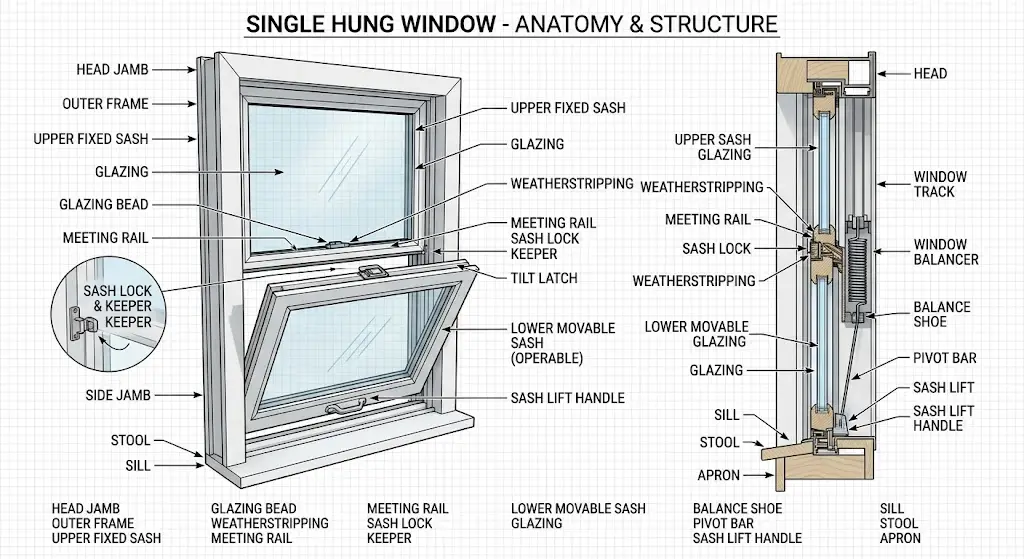
Snel naslagwerk voor onderdelen van enkelvoudige schuiframen & premium B2B-normen
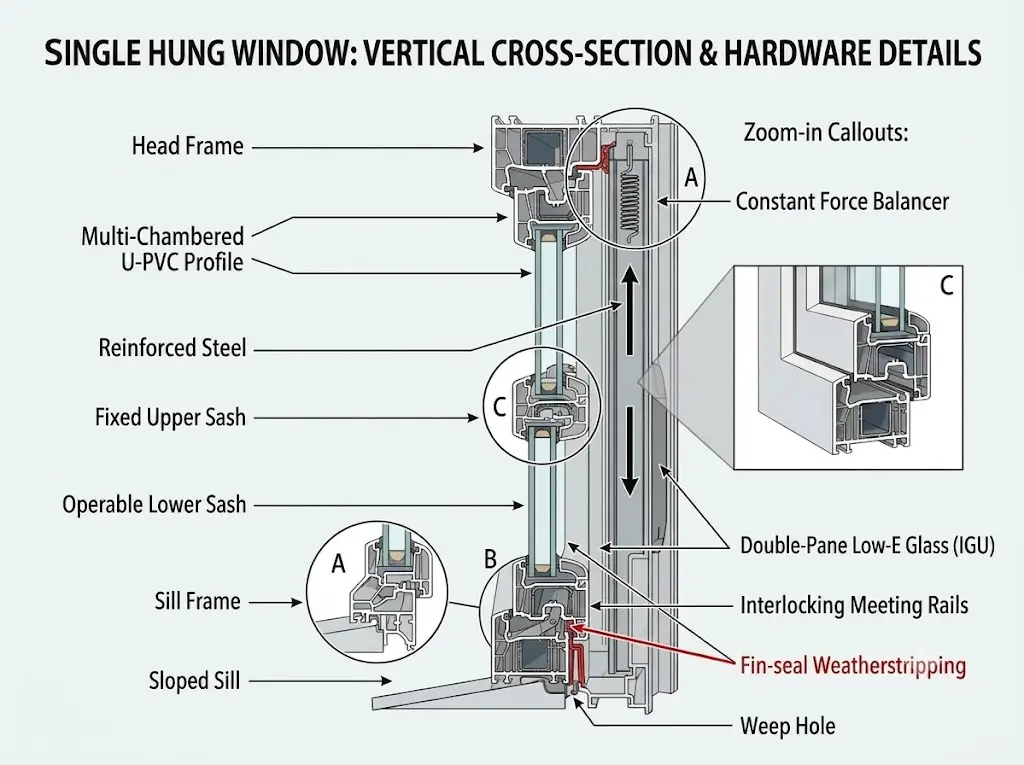
Voordat u de specificaties met een fabriek bevestigt, is het vaststellen van de basisterminologie en kwaliteitsnormen de eerste stap. Hieronder vindt u een overzicht van de belangrijkste hardwarecomponenten, hun functies en de belangrijkste normen en valkuilen waar u op moet letten tijdens het inkoopproces:
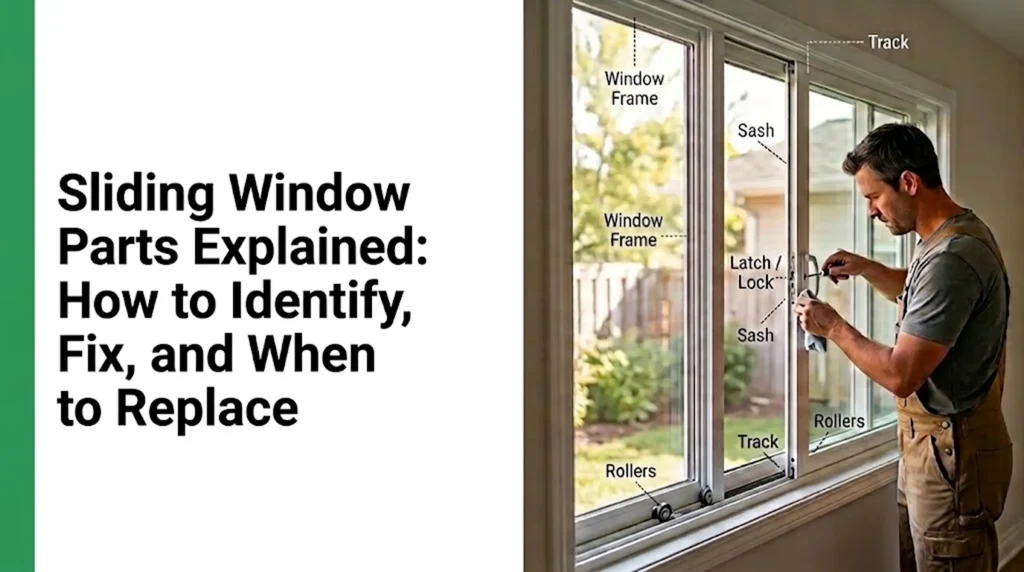
| Onderdeelnaam | Locatie | Basisfunctie | Hoogwaardige technische standaard | Aankoopvalkuilen en -aantekeningen |
| Kader(Kop, dorpel, deurposten) | De buitenste rand die het hele raam omsluit. | De vensterbank verankert het raam in de muuropening, ondersteunt interne componenten en zorgt voor de waterafvoer. | De wanddikte van de U-PVC moet het volgende bereiken: 2,5 mm-2,8 mmDikte van het hoofddragende profiel van aluminium ≥ 1,4 mm. | De onderste vensterbank moet een schuine vorm hebben. Platte vensterbanken leiden gemakkelijk tot waterophoping en lekkages naar binnen bij hevige regenval. |
| Vaste bovenste raamvleugel | De bovenste helft van het raam. | Hiermee wordt het bovenste glaspaneel vastgehouden. Bij een enkelvoudig schuifraam is het stevig aan het kozijn bevestigd en niet beweegbaar. | Naadloos afgewerkte hoekverbindingen. | U dient te controleren of het totale gewicht van het glas de structurele draagkracht van het gekozen profiel overschrijdt om vervorming te voorkomen. |
| Beweegbaar onderste raam | De onderste helft van het raam. | Het houdt het onderste glaspaneel vast. Het is het enige beweegbare onderdeel dat verticaal schuift en naar binnen kantelt. | Soepele werking zonder merkbare fysieke wrijving of abnormaal geluid. | Maattoleranties moeten uiterst nauwkeurig zijn. Te veel speling veroorzaakt lucht-/waterlekkages; te veel speling zorgt ervoor dat het raam vastloopt. |
| Raambalancer | Verborgen in de rails van de linker- en rechterzijstijlen. | Het fungeert als een ophangsysteem, dat het gewicht van het onderste raamdeel compenseert, zodat het moeiteloos opent en in de lucht blijft hangen. | Gebruik constante krachtbalancers met spiraalveren van 301 roestvrij staal, die al meer dan een jaar de AAMA-vermoeidheidstests doorstaan. 20.000 cycli. | Gebruik absoluut geen goedkope, verouderde spiraalveerbalanssystemen. Deze zijn gevoelig voor metaalmoeheid en breken vaak binnen zes maanden bij veelvuldig gebruik, waardoor het raamkozijn naar beneden zakt. |
| Draaistang en schoen | De stang bevindt zich onderaan het onderste raamkozijn, de schoen zit in de geleiderail van het kozijn. | Het draagt het gewicht van het raamkozijn, is verbonden met de balansas en fungeert als draaias voor de naar binnen gerichte kanteling van het raamkozijn. | Gebruik zinkgegoten staven; de oppervlakteafwerking moet aan de volgende eisen voldoen: 240 uur van de neutrale zoutneveltest (NSS). | Vermijd absoluut draaistangen van puur plastic, die gemakkelijk breken wanneer het gekantelde raam onder belasting staat. |
| Raamslot en sluitplaat | Geplaatst op de horizontale verbindingsrail waar de boven- en onderramen samenkomen. | Door de vergrendeling worden de raamvleugels strak tegen elkaar getrokken, wat zorgt voor veiligheid en luchtdichtheid. | Gemaakt van een robuuste zink- of aluminiumlegering, die bestand is tegen ASTM F588 Testen op weerstand tegen inbraak. | Een hoge vergrendelingstolerantie is vereist. Eenmaal vergrendeld, mag het duwen/trekken aan het onderste raamdeel geen speling of losheid vertonen. |
| Kantelgrendels | Aan de linker- en rechterkant van de bovenste rail van het onderste raamkozijn bevinden zich deze. | Houd het raamkozijn in de rails; door het naar binnen te duwen, kan het raamkozijn naar binnen kantelen om het schoon te maken. | Gemaakt van UV-bestendig, zeer sterk nylon, of kies voor verborgen metalen sluitingen. | Pas op voor goedkope plastic sluitingen. Bij intense blootstelling aan UV-straling worden ze binnen 1-2 jaar extreem broos en breken ze bij lichte druk. |
| Weerbestendige afdichting | Ingebed in de kieren rond de randen van de raamkozijnen en de binnenframes. | Vult kieren op om te voorkomen dat warme/koude buitenlucht, regen en geluid binnendringen. | Gebruik Fin-seal tochtstrips (met een kunststof barrière) om te voorkomen dat er lucht door het raam naar binnen dringt. < 0,30 cfm/ft². | Controleer strikt of de paalhoogte (doorgaans 0,250″-0,300″) sluit perfect aan op de ontworpen openingen van het profiel. |
Voorbij de standaard: de ultieme configuratie- en budgetbeslissingsmatrix
Hoogwaardige woon- en bedrijfsprojecten vereisen vaak specifieke configuraties die verder gaan dan standaardproducten. Elke upgrade heeft echter wel invloed op de kosten van uw project.
Om u te helpen weloverwogen beslissingen te nemen, hebben we onze aanpassingsmogelijkheden omgezet in een strategische beslissingsmatrix. Deze gids beschrijft de kernfuncties, de beste toepassingsscenario's en de relatieve kostenimpact van elke optie, zodat u de architectuurvereisten kunt afstemmen op uw inkoopbudget.
1. Frameprofielen en materiaalupgrades
De juiste framekeuze zorgt voor een probleemloze installatie, maar het materiaal bepaalt de structurele stevigheid en de basisprijs van uw gehele bestelling.
| Configuratieoptie | Kernfunctie en voordeel | Beste toepassingsscenario's | Relatieve kostenimpact |
| Bevestiging van het vinframe | Voorzien van geïntegreerde buitenflenzen voor snelle, weerbestendige installatie op houten frameconstructies. | Nieuwbouwprojecten en grootschalige woningbouwontwikkelingen. | $ (Basiskosten) |
| Blokframe (vlak) | Gladde buitenkozijnen die zo ontworpen zijn dat ze moeiteloos in bestaande openingen schuiven zonder de buitenmuren te beschadigen. | Vervangings- en renovatieprojecten, opknapbeurt van historische gebouwen. | $ (Basiskosten) |
| Hoogwaardig U-PVC | Biedt maximale thermische prestaties (lage U-waarde) en vereist geen onderhoud. | Woningbouw in de buitenwijken, appartementencomplexen, energiezuinige projecten. | $$ (Zeer kosteneffectief) |
| Thermische onderbreking aluminium | Biedt extreme structurele sterkte voor grotere raamoverspanningen, terwijl de isolatie behouden blijft dankzij een thermische barrière van polyamide. | Commerciële hoogbouw, luxe moderne villa's, zware toepassingen. | $$$$ (Premium investering) |
2. Glasselectie en akoestische prestaties
De isolerende glaseenheid (IGU) beslaat meer dan 701 TP6T van het raamoppervlak. Bij commerciële projecten is het van cruciaal belang om een balans te vinden tussen thermische efficiëntie, geluidsisolatie (STC) en budget.
| Glasconfiguratie | Belangrijkste prestatiehoogtepunten | Beste toepassingsscenario's | Relatieve kostenimpact |
| Standaard Low-E + Argon | Uitstekende thermische isolatie; blokkeert standaard UV-straling; voldoet aan de basisnormen van ENERGY STAR. | Algemene woningbouwprojecten, standaard kantoorgebouwen. | $$ (Industriële basislijn) |
| Asymmetrisch gelamineerd (akoestisch) | Uitstekende geluidsisolatie (STC 30+); blokkeert 99% UV-straling; voorkomt splinterpenetratie. | Appartementen aan de straatkant, hotels langs de luchthaven/snelweg, scholen. | $$$ (Gemiddelde Premium) |
| Slagvast gehard | Extreem hoge structurele sterkte; bestand tegen hoge windbelastingen en rondvliegend puin. | Kustprojecten (orkaangebieden), winkelruimtes op de begane grond. | $$$$ (Hoge Premium) |
| Getint / Reflecterend Low-E | Maximaliseert de beheersing van de zonnewarmtewinstcoëfficiënt (SHGC); vermindert verblinding en de kosten voor binnenkoeling. | Regio's met intense zonneschijn gedurende het hele jaar en commerciële gevels die grotendeels uit glas bestaan. | $$$ (Lichte toeslag) |
3. Esthetische roosters en raamstijlen
Roosters verhogen de architectonische stijl van uw gevels, maar de productiemethode heeft een aanzienlijke invloed op de uiteindelijke prijs.
| Grille-optie | Kernfunctie en voordeel | Beste toepassingsscenario's | Relatieve kostenimpact |
| Geen roosters (transparant) | Onbelemmerd uitzicht en maximale natuurlijke lichtinval. | Moderne minimalistische architectuur, hedendaagse hoogbouw. | $ (Basiskosten) |
| GBG (Grilles Between Glass) | Aluminium staven zijn in het glas ingekapseld. Dit zorgt voor een klassieke uitstraling en een glad glasoppervlak dat gemakkelijk schoon te maken is. | Standaard woningbouwprojecten, onderhoudsarme appartementen. | $$ (Lage Additie) |
| SDL (Simulated Divided Lites) | Roosters zijn aan de binnen- en buitenkant van het glas bevestigd, waardoor een authentieke, historische 3D-dimensie ontstaat. | Luxe villa's, renovaties van monumentale panden, exclusieve klassieke landgoederen. | $$$ (Belangrijke toevoeging) |
4. Hardware-upgrades en afwerking op elkaar afstemmen
Hardware moet niet alleen duurzaam zijn, maar ook naadloos aansluiten bij de interieurstijl zonder het budget te overschrijden.
| Hardware-optie | Kernfunctie en voordeel | Beste toepassingsscenario's | Relatieve kostenimpact |
| Standaard wit beslag | Duurzaam en past naadloos bij standaard witte U-PVC-profielen. | Budgetbewuste projecten, standaard huurwoningen voor meerdere gezinnen. | $ (Basiskosten) |
| Aangepaste kleurafwerkingen | Matzwart, architectonisch brons of geborsteld nikkel als afwerking, passend bij donkere profielen. | Exclusieve interieurontwerpen, lofts in industriële stijl, op maat gemaakte commerciële ruimtes. | $$ (Lichte toeslag) |
| Automatische vergrendelingsmechanismen | Het systeem vergrendelt en sluit het raam automatisch zodra het dichtgeduwd wordt, waardoor gebruikersfouten worden voorkomen. | Hoogbeveiligde complexen, luxe woonhuizen, seniorenwoningen. | $$$ (Matige toevoeging per eenheid) |
5. Schermconfiguraties
De ventilatie-ervaring afstemmen op de specifieke omgeving van uw doelgroep.
| Schermoptie | Kernfunctie en voordeel | Beste toepassingsscenario's | Relatieve kostenimpact |
| Standaard glasvezel | De duurzame, kosteneffectieve industriestandaard voor uitstekende luchtcirculatie en insectenbescherming. | Vrijwel alle standaard toepassingen voor woningen en bedrijven. | $ (Inbegrepen / Basiskosten) |
| Clear Advantage Mesh | Fijnmazig gaas dat van binnenuit praktisch onzichtbaar is, waardoor er maximaal natuurlijk licht binnenkomt en de uitstraling van de woning verbetert. | Landschapswoningen, luxe huizen met een onbelemmerd uitzicht. | $$ (Lage Additie) |
| Stevig huisdiergaas | Extra dik, scheurvast gaas, ontworpen om krassen en zware stoten te weerstaan. | Huisdiervriendelijke wooncomplexen, huurwoningen, appartementen op de begane grond. | $$$ (Matige Additie) |
Inkoopvalkuilen: 3 fatale fouten bij bulkbestellingen die tot kostenbesparing leiden
Of u nu een huiseigenaar bent die een enkel raam vervangt of een architect die een complex ontwerpt, de bovenstaande configuraties dienen als uw ultieme kwaliteitsnorm. Bent u echter een aannemer, groothandel of projectontwikkelaar die in grote hoeveelheden inkoopt, dan zijn de risico's exponentieel hoger – let dan goed op deze drie fatale valkuilen bij de inkoop.
In de B2B-groothandel is de grootste angst om in eerste instantie een klein bedrag te besparen, maar later enorme verliezen te lijden door verborgen kwaliteitsgebreken. Veel van deze problemen komen pas aan het licht na de oplevering van het project. Hieronder volgen de meest voorkomende valkuilen bij de internationale inkoop van ramen:
Fout 1: Je uitsluitend concentreren op het glas en de verborgen "balancers" negeren.
- Het gevolg: Om de productiekosten te drukken, nemen kopers genoegen met goedkope spiraalveersystemen. Binnen zes maanden begeven de veren het, blijft het onderste raamdeel niet meer openstaan of valt het abrupt naar beneden, wat leidt tot ernstige veiligheidsklachten en kostbare schadeclaims.
- De juiste aanpak: Vermeld expliciet in uw materiaallijst (BOM) of het om constante kracht- of katrolbalancers gaat en controleer of het gewicht dat ze aankunnen exact overeenkomt met het werkelijke gewicht van het door u gekozen glas.Fout 2: Kiezen voor goedkope plastic onderdelen
- Het gevolg: Het gebruik van standaard plastic voor kantelsluitingen of raammechanismen. In regio's met intense UV-straling verkleuren deze materialen, worden ze broos en breken ze gemakkelijk binnen een jaar of twee.
- De juiste aanpak: Eis dat alle dragende kunststof onderdelen van UV-bestendig nylon worden gemaakt, of, indien het budget het toelaat, direct overstappen op bevestigingssystemen van gegoten zink.Fout 3: Het over het hoofd zien van de structuur en dichtheid van de tochtstrips.
- Het gevolg: Bij gebruik van standaard tochtstrips van zuivere pool zonder barrière. Tijdens zware stormen kan niet alleen de wind erdoorheen komen, maar kan water ook rechtstreeks langs de afdichting waaien, wat schimmelvorming in muren en vloeren kan veroorzaken.
- De juiste aanpak: Specificeer Fin-seal tochtstrips. De dunne plastic lamellen in het midden van de paal vormen de belangrijkste barrière tegen lucht- en waterinfiltratie.
De evaluatiegids: Hoe u een betrouwbare buitenlandse fabrikant kunt beoordelen
Het kennen van de specificaties en het beschikken over een lijst met standaarden is slechts de helft van het werk. Het feilloos uitvoeren van deze details op commerciële schaal vereist een productiepartner met bewezen B2B-ervaring. Voordat u een volledige containerorder plaatst bij een buitenlandse leverancier, evalueer dan hun algehele sterkte op deze 4 kernpijlers:
1. Echte kwaliteitscontrole: vraag altijd om een "hoekgesneden proefexemplaar".
Glanzende productcatalogi bieden geen garantie voor vakmanschap in de praktijk. Vraag daarom altijd om een proefstuk van 30 x 30 cm (12 x 12 inch) met doorsneden van het hang- en sluitwerk en het glas. Alleen door de dikte van het profiel fysiek te voelen, de lasnaden in de hoeken te inspecteren en het slotmechanisme met eigen handen te testen, kunt u vaststellen of de fabriek de strikte maattoleranties hanteert die nodig zijn voor een goede kwaliteitscontrole.
2. Echte OEM/ODM-maatwerkcapaciteit en naleving van de regelgeving
Een betrouwbare partner verkoopt niet zomaar standaardproducten; ze passen zich naadloos aan uw architectonische blauwdrukken aan.
- Ontwerpafstemming: Of je nu matzwarte onderdelen nodig hebt die passen bij donkere profielen of specifieke grille-patronen, de fabriek moet flexibele mogelijkheden bieden voor esthetische personalisatie.
- Code-naleving: Exact hetzelfde raam dat naar Florida wordt verzonden, moet bestand zijn tegen orkanen, terwijl verzending naar Canada juist een extreem lage U-waarde vereist. De fabriek moet in staat zijn om de constructie aan te passen aan de lokale bouwvoorschriften van uw bestemming.
3. Stabiliteit van de toeleveringsketen en garanties voor levertijden
Leveringsvertragingen bij volle containers worden zelden veroorzaakt door een trage extrusie van profielen; ze ontstaan meestal doordat een klein hardware-onderdeel niet op voorraad is. B2B-kopers zijn zeer gevoelig voor levertijden. Een superieure fabrikant implementeert veiligheidsvoorraadbeheer voor veelgevraagde, technische kernonderdelen, waardoor bulkbestellingen van containers nooit vertraging oplopen door tekorten aan kleine onderdelen.
4. Professionele exportverpakking en containerlading
Het vervoer van glasproducten over lange zeereizen brengt extreme risico's met zich mee. Controleer vóór het tekenen van het contract of de fabriek gebruikmaakt van ongefumigeerde houten pallets, beschermfolie op het glas aanbrengt en professionele stuwzakken en stevige spanbanden gebruikt om de producten in de container te beveiligen en zo de kans op breuk tot bijna nul te beperken.
Conclusie: Bouw betere projecten met Hotian Windows
Inzicht in de exacte anatomie, materiaalkeuze en hardware-specificaties van enkelvoudige schuiframen is de beste manier om kostbare aankoopfouten te voorkomen. Echte prijs-kwaliteitverhouding betekent duurzame kwaliteit voor uw projecten zonder onnodige merkpremies te betalen.
Bij Hotian-venstersWij zijn gespecialiseerd in de productie en export van architectonische ramen die strikt voldoen aan deze strenge B2B-normen. Van robuuste extrusieprofielen tot gegarandeerde levertijden voor volle containerladingen, wij bieden transparante, totaaloplossingen voor de productie, afgestemd op uw bouwtekeningen.
Bent u klaar om uw groothandelsketen te verbeteren of uw leveranciers voor een aankomend commercieel project te optimaliseren? Bezoek ons op https://hotianwindows.com/ Vraag vandaag nog uitgebreide specificatiebladen, CAD-details, hoekstukmonsters en scherpe prijzen voor volle containers aan.