Les systèmes de murs-rideaux coûtent entre 90 et 130 €/pi² installés, contre 140 à 200 €/pi² pour les murs-rideaux. Les murs-rideaux sont moins chers de 30 à 50 € car ils sont installés entre les dalles de plancher (assemblage sur site) au lieu de couvrir plusieurs étages (éléments préfabriqués). Installation : un mur-fenêtre nécessite moins de main-d’œuvre (60 à 90 €/pi² contre 100 à 180 €/pi²) et son installation est plus rapide (5 à 7 semaines contre 8 à 12 semaines pour 20 000 pi²). Sur 30 ans, un mur-fenêtre coûte… $4.13-5.83/pi²/an par rapport à un mur-rideau $5,48-7,80/pi²/an (25-33% coût de cycle de vie moins cher).
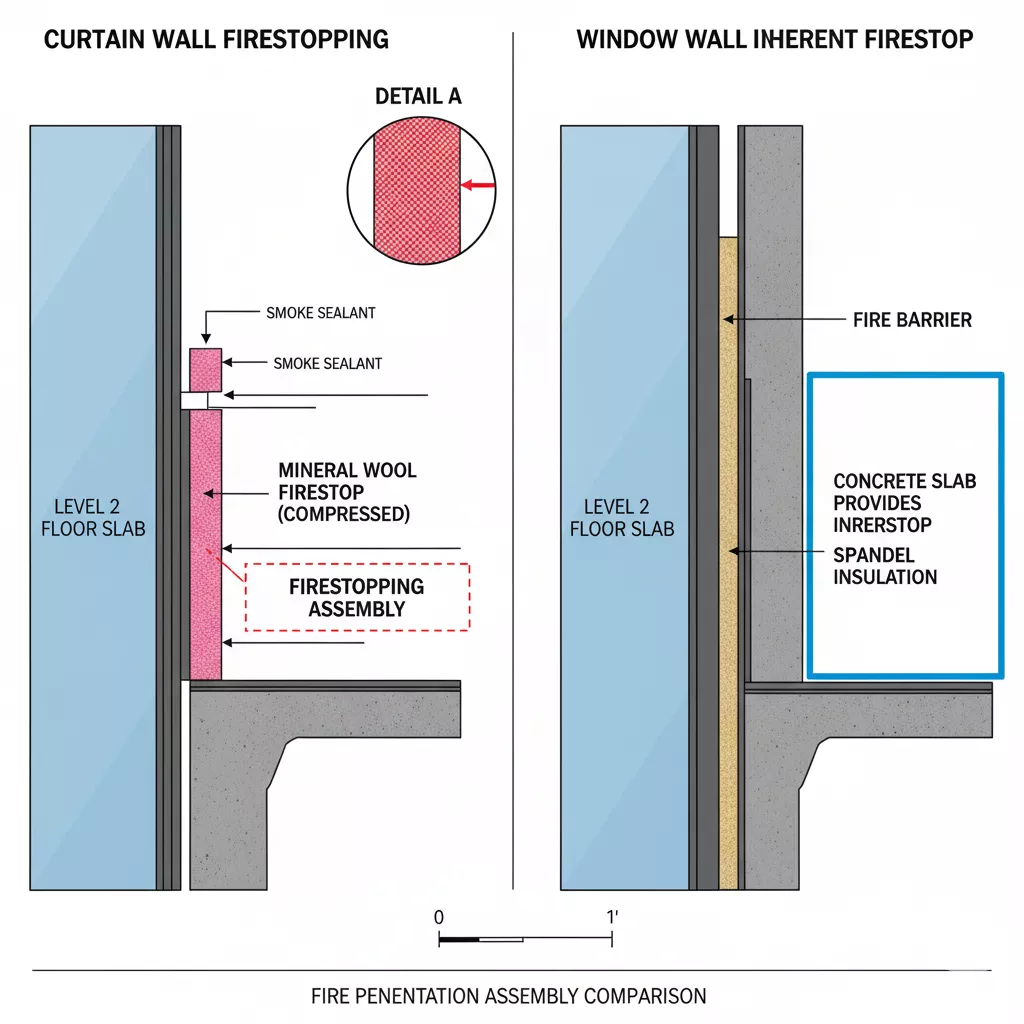
Du point de vue structurel, le mur-fenêtre convient aux bâtiments de 12 à 15 étages maximum ; le mur-rideau est obligatoire pour les bâtiments de plus de 20 étages en raison des charges de vent (plus de 257 km/h) et des mouvements structurels (différence de 19 mm). Protection contre l'incendie : le mur-fenêtre offre une protection intrinsèque (dalle = barrière coupe-feu), tandis que le mur-rideau nécessite des systèmes d'ingénierie (indice de protection thermique +10-15/m linéaire). Acoustique : le mur-fenêtre est supérieur (chaque étage est isolé par la dalle, indice d'affaiblissement acoustique [STC] de 45 à 52) au mur-rideau (pontage acoustique vertical, STC de 38 à 42).
Cadre décisionnelOptez pour une façade vitrée si vous construisez dans un immeuble résidentiel de moyenne hauteur (3 à 15 étages), que votre budget est limité, que l'isolation acoustique est primordiale et que vous souhaitez des fenêtres ouvrantes. Choisissez un mur-rideau si vous construisez dans un immeuble de plus de 15 étages, dans une zone exposée aux vents forts, si vous recherchez une esthétique de verre continu ou si vous avez besoin d'une durée de vie de 40 à 50 ans pour un bâtiment institutionnel ou commercial.
Pourquoi cette décision est plus importante que vous ne le pensez
Chez Hotian, nous fabriquons des systèmes de murs-fenêtres et de murs-rideaux depuis plus de 15 ans., fournissant plus de 200 projets commerciaux, allant de tours résidentielles de moyenne hauteur nécessitant une isolation acoustique à des immeubles institutionnels de grande hauteur exigeant une durabilité de 50 ans et une certification anti-ouragan de Miami-Dade.
Ce que nous avons appris de l'analyse des données de performance du projetL'idée que « la façade vitrée est bon marché, la façade rideau est haut de gamme » omet un critère de décision essentiel (70%). Le coût initial n'est qu'un facteur parmi d'autres : il faut également prendre en compte les limitations de hauteur du bâtiment, l'impact du délai d'installation sur le financement du projet, les coûts de maintenance tout au long du cycle de vie et les exigences de performance imposées par la réglementation, qui rendent un système incontournable.
Ce guide offre un aperçu complet des aspects techniques et financiers. Grâce à des données auxquelles la plupart des articles comparatifs n'ont pas accès : structures de coûts de production, analyse du coût du cycle de vie sur 30 ans, seuils de performance en fonction de la hauteur des bâtiments, données sur la main-d'œuvre et les délais d'installation, et marges bénéficiaires des entrepreneurs, vous saurez précisément quel système convient à votre projet, non pas sur la base de conseils génériques, mais grâce à une analyse technique et financière rigoureuse des compromis.
À qui cela est-il utile ?:
- Architectes et ingénieursMatrice de décision relative à la hauteur des bâtiments, exigences réglementaires, données de performance
- DéveloppeursAnalyse du retour sur investissement sur 30 ans, impact du calendrier sur les coûts de financement
- entrepreneurs généraux: Ventilation des coûts d'installation, stratégies de réduction des délais, marges bénéficiaires
- Propriétaires et gestionnaires immobiliers: Coûts de maintenance du cycle de vie, cycles de remplacement


La réalité des coûts : de l'usine au cycle de vie
Voici ce que la plupart des articles comparatifs ne vous diront pas.La différence de prix entre le 30-50% au détail est en réalité plus importante au niveau de l'usine (le 63% est plus cher pour les matériaux de murs-rideaux), mais les différences de main-d'œuvre à l'installation réduisent cet écart. Plus important encore, personne ne calcule le coût total de possession sur 30 ans.
Répartition des coûts de production (à partir de plus de 200 projets Hotian)
Structure des coûts de fabrication par pied carré:
| Composante de coût | Mur de fenêtre | Mur-rideau (préfabriqué) | Pourquoi la différence ? |
|---|---|---|---|
| Extrusion d'aluminium | $18-25 | $28-40 | Le mur-rideau nécessite des meneaux structurels d'une portée de 10 à 15 pieds (contre 8 à 10 pieds entre les dalles) ; d'une épaisseur plus importante (0,125″ contre 0,090″). |
| Verre (unité isolée de 1 pouce) | $22-30 | $22-30 | Même spécification de verre – aucune différence |
| Rupture thermique/joints | $4-6 | $8-12 | Le mur-rideau nécessite un système de pare-pluie à pression équilibrée avec double joint ; le mur-fenêtre utilise un simple joint d'étanchéité. |
| Matériel/ancrage | $6-10 | $15-25 | Les ancrages pour murs-rideaux supportent la charge du vent et le poids propre sur plusieurs étages ; supports techniques plutôt que simples clips |
| main-d'œuvre d'assemblage en usine | $10-15 | $25-40 | mur-fenêtre = cadre pré-vitré uniquement ; mur-rideau = panneau unitaire complet avec essais de structure |
| Expédition/emballage | $2-4 | $8-15 | Les modules de murs-rideaux sont 3 à 5 fois plus lourds, nécessitent un emballage sur mesure et leur empilabilité est limitée. |
| Coût usine (FOB) | $62-90 | $106-162 | Écart : $44-72 (63-80% et plus) |
| main-d'œuvre d'installation | $60-90 | $100-180 | Voir l'analyse d'installation ci-dessous |
| Ingénierie coupe-feu | Inclus (dalle) | $10-15 | Système coupe-feu technique requis |
| Coût total installé | $122-180 | $216-357 | |
| marge commerciale typique | 25-40% | 20-35% | |
| prix de détail installé | $90-130/pi² | $140-200/pi² | Écart : $50-70 (35-54% plus) |
Les idées essentielles
Analyse #1 : Équilibre entre les coûts de production et d’installation
- Écart de coût de production : 63-80% ($44-72/pi²)
- Écart de main-d'œuvre pour l'installation : 67-100% ($40-90/pi²)
- Écart total : 77% ($94-177/pi²)
En usine, le coût des murs-rideaux double presque. L'écart de prix pour la main-d'œuvre à l'installation est du même ordre de grandeur. Résultat : le prix de détail d'un mur-rideau est supérieur de 35 à 541 000 TP3 000 $ (écart réduit par la marge des entrepreneurs).
Perspective #2 : Économies d’échelle
Pour les grands projets (plus de 50 000 pieds carrés), prix direct usine disponibles :
- Mur-fenêtre : $50-70/pi² (FOB) → $105-145 installé
- Mur-rideau : $85-130/pi² (FOB) → $165-240 installé
- L'écart se réduit à 57-65% à grande échelle (par rapport au 77% à petite échelle)
Analyse #3 : Anomalie de la structure du balisage
Les entrepreneurs postulent pourcentage de marge inférieur mur-rideau (20-35%) vs mur-fenêtre (25-40%) car :
- Montant absolu en dollars plus élevé → même marge % = profit en dollars plus important
- La complexité de l'installation des murs-rideaux réduit la concurrence → moins de pression sur les prix
- Les installateurs spécialisés de murs-rideaux ont des frais généraux inférieurs (équipes dédiées, pas de main-d'œuvre générale).
Analyse du coût du cycle de vie sur 30 ans
Le principal point faible de chaque article comparatifPersonne ne calcule le coût total de possession sur toute la durée de vie du bâtiment.
Hypothèses pour une façade commerciale de 20 000 pieds carrés:
| Facteur de coût | Mur de fenêtre | Mur rideau | Méthode de calcul |
|---|---|---|---|
| Installation initiale (Année 0) | $1.8-2.6M | $2.8-4.0M | 20 000 pi² × $/pi² installé |
| cycle de remplacement du mastic | Tous les 7 à 10 ans | Tous les 12 à 18 ans | Joints posés sur chantier vs joints d'usine |
| Coût de remplacement du mastic (à chaque cycle) | $60-80K | $30-50K | Mur vitré : plus de joints (à chaque étage) ; mur rideau : moins de joints mais accès extérieur |
| Remplacement des mastics d'étanchéité en 30 ans | 3 cycles ($180-240K) | 2 cycles ($60-100K) | |
| remplacement du matériel/de l'opérateur | Année 15 ($120K) | Année 20 ($160K) | Aérations fonctionnelles, mécanismes de verrouillage |
| Remplacement majeur des joints/joints d'étanchéité | Année 20 ($80K) | Année 25 ($100K) | Joints périmétriques |
| Nettoyage de façade (annuel) | $6K/an × 30 = $180K | $8K/an × 30 = $240K | Mur-rideau : accès extérieur plus difficile |
| Dégradation des performances thermiques | $40-80K | $0-20K | Mur-fenêtre : les fuites d’air au niveau des joints augmentent les coûts énergétiques (3-8%) sur 30 ans |
| Réparations imprévues (fuites, pannes) | $80-120K | $40-60K | Mur-fenêtre : plus de joints de champ = plus de risques de fuite |
| coût total sur 30 ans | $2,48-3,50M | $3,29-4,68M | |
| Coût par pied carré par an | $4.13-5.83 | $5.48-7.80 | Total ÷ 20 000 pi² ÷ 30 ans |
Observations clés
Le mur-fenêtre est 25-33% moins cher sur 30 ans, et pas seulement le 30-50%, moins cher à l'achat. Cependant :
La fréquence d'entretien est importante.Le mur-fenêtre 50% nécessite davantage d'interventions d'entretien (3 cycles d'application de mastic au lieu de 2, et plus de réparations imprévues). Pour les gestionnaires immobiliers, cela signifie :
- Perturbations supplémentaires pour les locataires (travaux extérieurs, installations temporaires)
- Une meilleure coordination avec les opérations du bâtiment
- Gestion accrue des garanties et des relations avec les sous-traitants
avantage du cycle de vie des murs-rideauxAchats à coût initial plus élevé :
- ✅ Moins de cycles de maintenance (40 à 50 interventions en moins)
- ✅ Risque de réparation imprévue réduit (contrôle qualité en usine vs assemblage sur site)
- ✅ Planification des investissements plus prévisible (maintenance programmée, et non réactive)
Pour les propriétaires institutionnels/commerciaux avec des périodes de détention de 40 à 50 ansLa durabilité supérieure des murs-rideaux justifie souvent un prix plus élevé malgré un coût total plus important.
💡 Conseil de pro pour les développeurs :
Compression des horaires = économies sur les coûts de financementL'installation plus rapide du mur-fenêtre (3 à 5 semaines) accélère l'obtention du certificat d'occupation :
- Intérêts du prêt construction : 3 à 5 semaines × $ (projet de 50 M) × 8% (taux annuel) = $ (économies de 150 000 à 300 000)
- Revenus locatifs antérieurs : taux d'occupation d'un mois antérieur × $80K/mois (immeuble de 100 unités) = $80K
- Valeur totale de l'installation plus rapide : $230-380K en plus des économies de matériel et de main-d'œuvre du $1M
Pour les projets à valeur ajoutée ou les projets de construction par des marchands, le délai d'occupation l'emporte souvent sur la différence de coût des matériaux.
Matrice de décision relative à la hauteur des bâtiments : Quand chaque système fonctionne
La question la plus courante« À quelle hauteur dois-je passer d'un mur-fenêtre à un mur-rideau ? »
La réponseIl ne s'agit pas seulement de la hauteur ; il faut aussi prendre en compte la charge du vent, les mouvements de la structure, la pression thermique et les exigences des codes locaux. Voici une analyse technique détaillée.
Performances par plage de hauteur
| Plage de hauteur | Pression du vent | Déflexion du plancher | Pile thermique | Un mur vitré est-il envisageable ? | Mur-rideau requis ? | Notes de code |
|---|---|---|---|---|---|---|
| 1 à 6 étages | <15 PSF (90 mph) | Minimal (<1/8″) | <0,1 PSF | ✅ Oui (standard) | ❌ Surdimensionné | Un mur-fenêtre est suffisant ; un mur-rideau ajoute 40 à 60% de coût sans avantage. |
| 7 à 12 histoires | 15-25 PSF (90-120 mph) | Modéré (1/8″-1/4″) | 0,1-0,3 PSF | ✅ Oui (la plupart des projets Hotian) | En option (luxe) | Supporte les charges avec des ancrages appropriés |
| 13 à 20 histoires | 25-40 PSF (120-140 mph) | Significatif (1/4″-1/2″) | 0,3-0,6 PSF | ⚠️ Marginal | ✅ Recommandé | Nécessite des tests approfondis ; l'analyse sismique DE nécessite un rideau |
| 21 à 30 histoires | 40-60 PSF (140-160 mph) | Haut (1/2″-3/4″) | 0,6-0,9 PSF | ❌ Non recommandé | ✅ Obligatoire | Le mouvement dépasse les joints des murs-fenêtres. |
| Plus de 30 histoires | 60+ PSF (160+ mph) | Très élevé (3/4″-1″+) | 0,9-1,5+ PSF | ❌ Interdit | ✅ Obligatoire | ASCE 7 + ASTM requis |
Explication des facteurs d'ingénierie
Facteur #1 : Pression du vent
Formule: P=0,00256×V2×Kz×KdP = 0,00256 \times V^2 \times K_z \times K_dP=0,00256×V2×Kz×Kd (PSF)
- À 160 mph : 65 PSF → dépasse le mur de la fenêtre (400-800 lb/pied linéaire) mais les poignées de rideaux (1 200-2 500 lb/ancrage).
Facteur #2 : Mouvement différentiel du plancher
Combiné : 1/4″-3/4″ à 20 étages → les joints des murs-fenêtres cèdent (>1/2″).
Facteur #3 : Effet de pile thermique
Exemple: 300 ft, 0°F dehors/70°F dedans : ΔP=0,76\Delta P = 0,76ΔP=0,76 PSF → gains à pression de rideau égalisée.
💡 Conseil de pro pour les ingénieurs en structure :
Murs-fenêtres techniques jusqu'à 18 étages (plus de 20 cas Hotian) : vitrage silicone + supports intermédiaires. Économies de $1,8M/40 000 pi².
Analyse des coûts et des délais d'installation
L'atout majeur du mur vitré : main-d'œuvre et délais.
Répartition des travaux d'installation (20 000 pi²)
| Composant | Mur de fenêtre | Mur rideau | Différence |
|---|---|---|---|
| Travail des champs | $60-90/pi² | $100-180/pi² | 67-100% plus |
| Taille de l'équipage | 4-6 | 6 à 10 + gréeurs | 50-100% plus |
| Grue | $8-15K | $45-80K | $37-65K premium |
| tarif journalier | 400 à 600 pieds carrés/jour | 250-400 | 40-60% plus rapide |
| Temps total | 5 à 7 semaines | 8 à 12 semaines | 17 à 30 jours plus rapide |
Pourquoi plus rapideAccès intérieur, absence de dalle, pas de goulot d'étranglement lié à la grue.
Impact du financement (Projet $50M) :
| Facteur | Économies |
|---|---|
| Intérêts d'emprunt | $150-300K |
| Revenus anticipés | $80K/mois |
| Total | $230-830K |
Performances : Feu, Acoustique, Thermique
| Métrique | Mur de fenêtre | Mur rideau | Gagnant |
|---|---|---|---|
| Feu | Inhérent (dalle 2 heures) | +$10-15/pi conçu | Fenêtre ✅ |
| STC (étage-étage) | 45-52 | 38-42 | Fenêtre ✅ |
| Facteur U | 0.35-0.45 | 0.30-0.40 | Rideau |
| Fuite d'air | 0,20-0,40 CFM/pi² | 0.06-0.15 | Rideau |
Clé: Les fenêtres offrent des performances acoustiques et coupe-feu résidentielles ; les rideaux, une étanchéité à l’air institutionnelle.
Spécifications par type de bâtiment
- Résidentiel/Hôtel (3-15F): Mur vitré (acoustique + ouvrant).
- Bureau (15-30F): Mur-rideau (esthétique + hauteur).
- Institutionnel: Rideau (durée de vie de 50 ans).
- Usage mixte: Hybride (spécialité Hotian, économies de 25 à 35%).
Étui Hotian: 22F hybride à usage mixte a permis d'économiser $1,2M.
Cadre décisionnel
Mur de fenêtre Si:
- ≤15 étages, résidentiel, budget/calendrier serrés, priorité acoustique.
Mur-rideau Si:
- Plus de 15 étages, commercial, verre continu, longue durée.
HybrideIdéal pour un usage mixte.
Murs-fenêtres vs murs-rideaux (FAQ sur les immeubles de grande hauteur)
Peut-on utiliser un mur vitré au-dessus de 15 étages ?
Oui, grâce à l'ingénierie. Les murs-rideaux peuvent être installés au-delà de 15 étages lorsqu'ils sont conçus pour résister à des charges de vent plus élevées et à des mouvements différentiels. Les améliorations courantes comprennent :
- Vitrage structurel en silicone pour permettre une plus grande liberté de mouvement
- Supports horizontaux intermédiaires à mi-parcours (souvent tous les 5 à 8 étages)
- Joints d'étanchéité améliorés avec ~50% capacité de mouvement
Exigences critiques : tests de maquettes ASTM E283 (infiltration d'air) et ASTM E331 (pénétration de l'eau), plus analyse structurelle des mouvements différentiels.
Note sur les coûts : Les façades vitrées des immeubles de grande hauteur ajoutent souvent ~15–25% au-dessus d'une baie vitrée standard. En règle générale, au-dessus d'environ 15 à 18 histoires, les coûts d'ingénierie et les primes peuvent dépasser le coût de base d'un mur-rideau. Les murs-rideaux pourraient devenir plus économiques.
Quelle est la différence entre un mur-rideau modulaire et un mur-rideau à ossature bois ?
Mur-rideau modulaire (souvent recommandé) :
- Panneaux pré-assemblés en usine (cadre + vitrage + joints), installés unité par unité
- Meilleure cohérence et assurance qualité/contrôle qualité (environnement contrôlé)
- Installation sur site plus rapide (moins de vitrage et d'étanchéité sur site)
- Coût: typiquement ~20–30% plus haut que les constructions traditionnelles
Mur-rideau à ossature bois :
- Éléments livrés en pièces détachées et assemblés sur place ; vitrage installé sur le terrain
- Coût initial inférieur
- Une plus grande variabilité sur le terrain (la météo et les compétences de l'installateur ont plus d'importance)
- Installation plus lente (plus de joints scellés sur place)
Recommandation: unitisé pour les projets >50 000 pieds carrés ou des exigences de haute performance ; la construction traditionnelle peut convenir aux projets à budget limité <30 000 pi² où la flexibilité des horaires est possible.
Quelle est la durée de vie de chaque système ?
Mur vitré : typiquement 25 à 35 ans avec un entretien approprié.
- Remplacement du mastic : chaque 7 à 10 ans (souvent ~$3–4/pied linéaire)
- Matériel/opérateurs : environ un an 15–20 (souvent ~$6–8/pi²)
- Facteurs de fin de vie : défaillances des joints/garnitures d’étanchéité, dégradation du joint cadre-verre
Mur rideau: typiquement 40 à 50 ans avec entretien.
- Remplacement du mastic : chaque 12 à 18 ans (souvent ~$2–3/pied linéaire ; l'accès peut augmenter le coût total)
- Matériel : environ un an 20–25 (souvent ~$8–10/pi²)
- Facteurs de fin de vie : dégradation des joints, défaillance de la finition, modernisation majeure/mises à niveau des normes énergétiques
Quel système est le meilleur pour la certification LEED ?
Cela dépend des crédits que vous visez, mais les murs-rideaux offrent souvent une voie plus facile vers la performance énergétique.
Énergie et atmosphère (EA) :
- étanchéité à l'air des murs-rideaux (souvent ~0,06–0,15 CFM/pi²) peut surpasser les murs-rideaux classiques et contribuer à atteindre des objectifs de performance ambitieux.
- Mur vitré (souvent ~0,20–0,40 pi³/min/pi²) peut nécessiter des détails plus poussés pour atteindre les objectifs de faible fuite.
Matériaux et ressources (MR) :
- Les deux peuvent tirer parti du contenu en aluminium recyclé (couramment ~60–80%).
- L'assemblage en usine (unités modulaires) peut réduire les déchets sur le terrain.
Qualité de l'environnement intérieur (QEI) :
- Un mur vitré peut assurer une ventilation naturelle grâce à des fenêtres ouvrantes (lorsque cela est autorisé).
- Les murs-rideaux sont souvent à vitrage fixe, reposant davantage sur des stratégies de ventilation mécanique.
En résumé : Le mur-rideau est généralement la solution la plus simple pour Certification LEED Or/Platine performance énergétique ; un mur-fenêtre peut apporter une valeur ajoutée à une conception axée sur la ventilation.
Puis-je utiliser des murs-fenêtres dans les zones sismiques ?
Oui, si c'est bien détaillé pour le drift. Dans les zones sismiques de haute sismicité (souvent désignées par les lettres D et E), les plans nécessitent généralement :
- Capacité de mouvement articulaire accrue (pour permettre environ) ±1–2% dérive du scénario (selon l'ingénierie)
- Vitrage structurel en silicone pour permettre un mouvement contrôlé à l'interface verre/cadre
- Ancrages coulissants au niveau de la tête/du seuil pour permettre le mouvement sans déformation du cadre
Impact sur les coûts : Les détails parasismiques peuvent ajouter ~15–25% par rapport à une baie vitrée standard.
Alternative: Les systèmes de murs-rideaux gèrent souvent les mouvements sismiques de manière plus prévisible lorsqu'ils sont conçus comme un système de façade, et peuvent être plus économiques dans des conditions sismiques élevées malgré un coût de base plus élevé.
Qu’en est-il du contrôle de la fumée et de la propagation du feu ?
Mur vitré : a souvent un avantage car le Le bord de la dalle compartimente les étages, limitant la migration verticale de la fumée le long de la façade lorsqu'elle est correctement conçue.
Mur rideau: nécessite généralement des détails techniques plus poussés en matière de protection contre le feu et la fumée :
- Les cavités continues des façades peuvent créer des conduits de fumée verticaux.
- Nécessite coupe-feu et joint d'étanchéité à la fumée à chaque niveau d'étage
- Peut nécessiter NFPA 285 conformité des assemblages de murs extérieurs (en particulier pour les bâtiments de plus de 12 mètres où des composants combustibles sont présents)
Impact sur les coûts (concept budgétaire typique) : Les systèmes coupe-feu/fumée des murs-rideaux peuvent ajouter environ $10–15/pied linéaire × périmètre du bâtiment × nombre d'étages (selon le projet).
Il est toujours conseillé de se coordonner au plus tôt avec le consultant en façades, l'ingénieur en protection incendie et l'autorité compétente afin de confirmer la procédure d'assemblage et de test requise.