Les fenêtres en vinyle coûtent entre 450 et 800 $ (installation comprise, 90 cm x 150 cm) contre 600 à 1 200 $ pour les fenêtres en aluminium. Cependant, la différence de coût en usine n'est que de 40 à 60 $ ; l'écart s'explique par la marge bénéficiaire du détaillant, et non par le coût des matériaux. Sur 50 ans, l'aluminium… 18% moins cher ($17 000 au total contre $33 000 pour le vinyle, ce dernier devant être remplacé à 25 ans). Côté performance, l’aluminium à rupture de pont thermique moderne offre un coefficient U équivalent à celui du vinyle (0,30 contre 0,28–0,32) tout en assurant une résistance structurelle trois fois supérieure pour les grandes surfaces vitrées. En bord de mer, l’aluminium est indispensable (le vinyle se dégrade au contact de l’air salin en 10 à 15 ans).
Cadre décisionnel : Budget limité + climat intérieur + architecture traditionnelle = le vinyle est suffisant. Situation côtière + propriété à long terme + design moderne + usage commercial = l’aluminium justifie un surcoût. Pour les entrepreneurs, l’aluminium offre une marge brute de 35 à 40 % contre 30 % pour le vinyle.
Pourquoi cette comparaison est plus importante que vous ne le pensez
Chez Hotian, nous fabriquons des systèmes de fenêtres en aluminium et en vinyle depuis plus de 15 ans., fournissant plus de 500 projets résidentiels et commerciaux, allant des copropriétés côtières nécessitant la certification Miami-Dade aux développements à usage mixte à l'intérieur des terres où les contraintes budgétaires déterminent le choix des matériaux.
Ce que nous avons appris de l'analyse des données de performance du projetL’idée que « le vinyle est bon marché, l’aluminium est cher » est incomplète. Le prix d’achat initial ne représente que 301 TP3T de la réalité ; les 701 TP3T restants concernent la durée de vie, les cycles de remplacement, la performance climatique et le coût total de possession sur plusieurs décennies.
Cet article présente un aperçu complet des finances et des performances. Grâce à des données auxquelles la plupart des guides comparatifs n'ont pas accès : coûts de production, durée de vie réelle issue de centaines de projets, résultats de tests thermiques et marges bénéficiaires des entreprises de construction, vous saurez précisément quel matériau convient à votre situation, non pas sur la base de conseils génériques, mais grâce à une analyse chiffrée des compromis.
À qui cela est-il utile ?:
- PropriétairesComprendre le coût total sur toute la durée de vie, et pas seulement le prix affiché : il faut comprendre le coût total sur toute la durée de vie.
- Entrepreneurs et constructeurs: Voir les différences de marge bénéficiaire et les stratégies de spécification
- Gestionnaires immobiliersObtenez des données de retour sur investissement pour la planification des investissements.
- Architectes: Apprendre les implications structurelles et de conception
La réalité des coûts : marges d’usine vs marges de détail
Voici ce que la plupart des articles comparatifs ne vous diront pas : l’écart de prix considérable entre l’aluminium et le vinyle en magasin est principalement dû à complexité de l'installation et tarification en fonction de la valeur perçue—et non le coût des matières premières.
Ventilation des coûts de fabrication (fenêtre à battant 3'×5')
| Composante de coût | Fenêtre en vinyle | Aluminium à rupture de pont thermique | Pourquoi la différence ? |
|---|---|---|---|
| Matières premières | $35-45 | $55-75 | L'aluminium est une matière première commercialisée ; le PVC est un plastique extrudé |
| main-d'œuvre manufacturière | $20-30 | $35-50 | L'aluminium nécessite un assemblage par rupture thermique et un sertissage (et non pas seulement un soudage). |
| Quincaillerie/verre | $25-35 | $30-40 | Composants de qualité similaire |
| Prix usine (FOB) | $80-110 | $120-160 | Écart réel : $40-60 (50% de plus) |
| Chaîne de distribution | Fenêtre en vinyle | Aluminium à rupture de pont thermique |
|---|---|---|
| marge du distributeur | +$80-120 | +$100-150 |
| Achat par un entrepreneur | $160-230 | $220-310 |
| main-d'œuvre d'installation | $150-250 | $200-350 |
| marge de détail | +$140-320 | +$180-540 |
| Prix installé | $450-800 | $600-1,200 |
Les idées essentielles
Analyse #1 : Écart entre production en usine et vente au détail
Au niveau de l'usine, l'aluminium coûte 50% de plus que le vinyle ($120 contre $80). En magasin, cela coûte 33-50% de plus (Moyenne $900 vs $625L'écart en fait rétrécissements tout au long de la chaîne de distribution, car l'aluminium a une valeur perçue plus élevée.
Analyse #2 : La tarification en fonction du volume change tout
Pour les projets de plus de 20 fenêtres, les prix directs d'usine ou destinés aux entrepreneurs permettent d'éliminer une grande partie de la marge du détaillant :
- Vinyle: $160-230 par fenêtre (coût de l'entrepreneur)
- Aluminium: $220-310 par fenêtre (coût de l'entrepreneur)
L'écart se réduit à $60-80 par fenêtre (27% premium)
Insight #3 : Les coûts d’installation sont souvent égaux
Les installateurs expérimentés pratiquent des tarifs similaires pour les deux matériaux. La fourchette de prix « $200–350 pour l’aluminium » correspond aux scénarios les plus défavorables avec des équipes non préparées. Les coûts d'installation appropriés s'élèvent à 180-250 pour les deux matériaux..
💡 Conseil de pro pour les entrepreneurs :
Les projets d'aluminium commandent 35-40% marge brute par rapport au vinyle 30% en raison de sa valeur perçue (il est plus facile de justifier le surcoût auprès des clients). Pour un chantier de 20 fenêtres : filets en aluminium $6 000–9 000 de profit par rapport aux vinyles $3,600-5,000Le coût initial plus élevé est souvent un atout, et non un défaut : il permet de sélectionner les clients prêts à payer pour la qualité.
Analyse du coût total sur 50 ans : le chiffre qui change tout
Le principal point faible de chaque article comparatif : Personne ne calcule le coût total de possession sur toute la durée de vie d'un bâtiment..
Durée de vie par zone climatique (Données du projet Hotian, plus de 500 installations)
| Zone climatique | Durée de vie du vinyle | Durée de vie de l'aluminium | Mode de défaillance principal |
|---|---|---|---|
| Zone 1-2 (Chaud) | 18-25 ans | 35-45 ans | Vinyle : dégradation due aux UV, déformation au-dessus de 35 °C |
| Zone 3-5 (Mixte) | 20-30 ans | 35-50 ans | Vinyle : Défaillance du joint, décoloration du cadre |
| Zone 6-8 (Froide) | 20-28 ans | 30-45 ans | Vinyle : fragilité due au gel-dégel, défaillance des joints |
| Zone côtière (toutes zones) | 10-15 ans | 30-40 ans | Vinyle : L’air salin accélère les dommages causés par les UV et le farinage. |
Durée de vie moyenne pondérée (d'après la répartition des logements aux États-Unis) :
Vinyle de qualité : 22 ans
Aluminium à rupture de pont thermique : 38 ans
Coût total de possession sur 50 ans (20 fenêtres, maison moyenne)
| Facteur de coût | Vinyle de qualité | Aluminium à rupture de pont thermique |
|---|---|---|
| Installation initiale (Année 0) | $13,000 | $17,000 |
| Maintenance (années 1 à 22) | $200/an = $4 400 | $150/an = $3 300 |
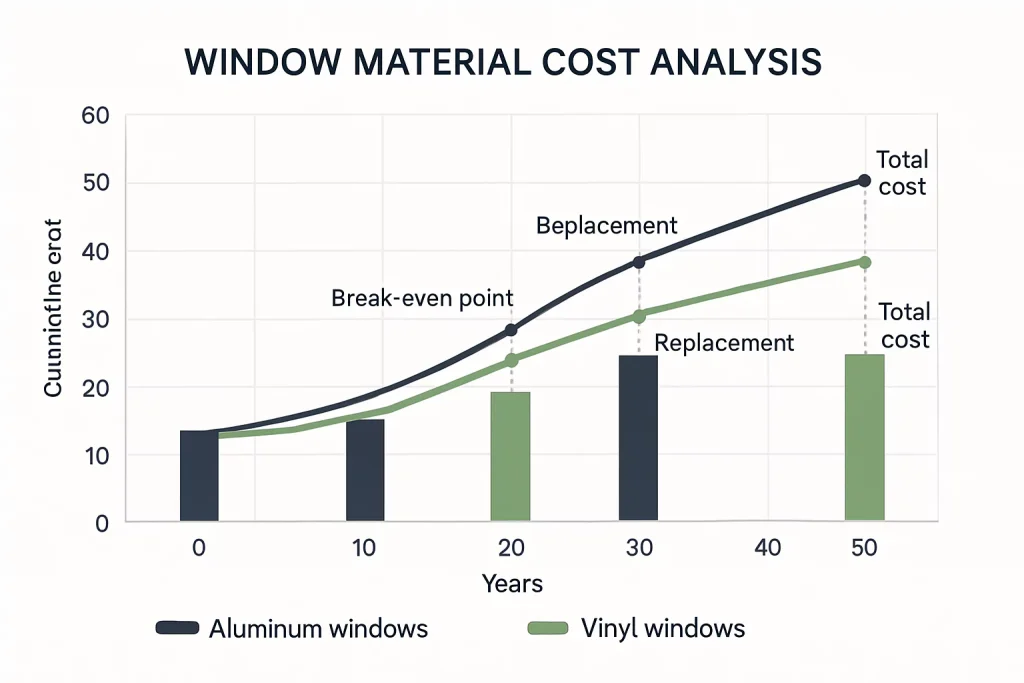
| Besoin d'un remplacement ? | Oui (Année 25) | Non |
| Coût de remplacement (ajusté à l'inflation 3%) | $26,500 | $0 |
| Maintenance (années 26-50) | $200/an = $5000 | $150/an = $3 750 |
| coût total sur 50 ans | $48,900 | $24,050 |
| coût annuel de possession | $978/an | $481/an |
Observation: L'aluminium coûte initialement plus cher (31%), mais 51% moins de 50 ansLe seuil de rentabilité est atteint à année 16—après cela, l'aluminium représente des économies pures.
Prime pour les propriétés côtières (à moins de 8 km de l'eau salée)
| Matériel | Coût initial | Premier remplaçant (12e année) | Deuxième remplacement (Année 24) | Total sur 30 ans |
|---|---|---|---|---|
| Vinyle | $13,000 | $20,800 | $28,100 | $61,900 |
| Aluminium | $17,000 | $0 | $0 | $21,500 (incl. $4,500 maintenance) |
Dans les zones côtières, le vinyle coûte 2,9 fois plus cher sur 30 ans..
💡 Conseil de pro pour les gestionnaires immobiliers :
Utilisez l'analyse du coût du cycle de vie pour la planification des investissements, et pas seulement pour le budget initial. Un immeuble de 100 appartements en copropriété en bord de mer fait face à $150,000-250,000 Les coûts imprévus de remplacement des fenêtres peuvent être importants entre la 10e et la 15e année si du vinyle a été choisi. L'aluminium permet d'éviter complètement cet appel de fonds, un point crucial pour la gestion du fonds de réserve et pour éviter les cotisations exceptionnelles.
La révolution de la rupture thermique : pourquoi « l’aluminium est froid » est un mythe des années 1980
La plus grande idée fausse concernant les fenêtres en aluminium : Ils sont énergivores..
La réalité : C'était vrai il y a 40 ans. La technologie moderne de rupture de pont thermique a complètement transformé les performances de l'aluminium.
L'évolution de l'ingénierie
Avant les ruptures thermiques (avant les années 1980)
- Cadre en aluminium massif = pont thermique continu
- Métal froid extérieur → contact direct → métal froid intérieur
- Coefficient U : 1,0-1,5 (isolation déplorable)
- Résultat : Condensation, formation de glace, perte de chaleur
Après la technologie de rupture thermique
- bande de polyamide (plastique renforcé) sépare physiquement l'aluminium extérieur et intérieur
- Largeur de la bande : 14-34 mm (Qualité commerciale Hotian : 24 mm)
- La chaleur ne peut pas se conduire à travers une barrière non métallique.
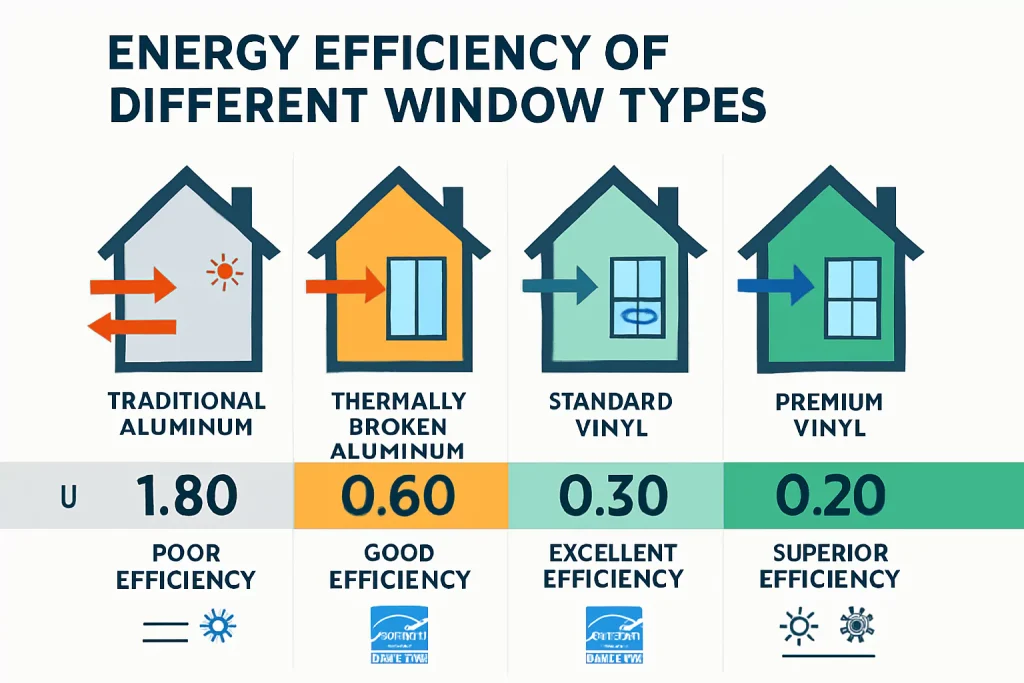
- Coefficient U : 0,28-0,35 (performance équivalente à celle du vinyle)
Données de performance réelles (testées par la NFCC)
| Type de fenêtre | Facteur U (Plus bas = mieux) | SHGC (Acquisition de chaleur solaire) | Coût énergétique (annuel, zone 5) |
|---|---|---|---|
| Vinyle standard (multichambre) | 0.28-0.32 | 0.25-0.30 | $280-320 |
| Aluminium à rupture de pont thermique (24 mm) | 0.30-0.35 | 0.28-0.35 | $290-350 |
| Vinyle haute performance (rempli de mousse) | 0.24-0.28 | 0.22-0.28 | $250-290 |
| aluminium standard (sans cassure) | 0.80-1.20 | 0.55-0.65 | $650-850 |
Principales observations :
- L'aluminium à rupture de pont thermique offre des performances à l'intérieur de 7 à 12% de vinyle en matière d'efficacité énergétique
- Différence de coût annuel : $10-30 dans la plupart des climats (économies négligeables par rapport à la durée de vie)
- Le vinyle haute performance conserve son tranchant, mais l'écart est minimal avec de l'aluminium de qualité
Quel est le coût d'une rupture thermique ?
- Coût de fabrication pour ajouter une rupture thermique : $15–25 par fenêtre au niveau de l'usine
- Supplément au détail : $80-150 par fenêtre
- Économies d'énergie : $40-80/an (climats froids) = Retour sur investissement en 2 à 4 ans
En résumé : Toute fenêtre en aluminium à usage résidentiel ou commercial devrait être équipée d'une rupture de pont thermique. Chez Hotian, c'est le cas. standard sur tous nos systèmes—pas une mise à niveau.
Performance par zone climatique : la matrice de décision
Les conseils génériques sont inefficaces dans ce cas : « Le vinyle pour les climats froids, l’aluminium pour les climats chauds » simplifie à l’excès une décision complexe.
Recommandations par zone
| Zone climatique | Description | Gagnant | Pourquoi? | Impact sur les coûts |
|---|---|---|---|---|
| Zone 1 (Chaud) | Miami, Phoenix étés de 90 à 110 degrés Fahrenheit | Aluminium ⭐⭐ | Le vinyle se déforme au-dessus de 35 °C ; la couleur s'estompe en 5 à 7 ans. | Le vinyle doit être remplacé 8 à 12 ans plus tôt. |
| Zone 2 (Chaud) | Houston, Atlanta Humide, 29-35 °C | Aluminium ⭐ | Exposition intense aux UV ; le vinyle se dégrade plus rapidement. L’aluminium est stable. | Durée de vie du vinyle : 18 à 22 ans contre 35 à 40 ans pour l’aluminium. |
| Zone 3-4 (Mixte) | Dallas, Charlotte Étés chauds, hivers doux | Soit ✅ | L'aluminium à rupture de pont thermique offre des performances satisfaisantes ; le vinyle conserve une légère isolation au niveau des bords. | <$50/an différence de coût énergétique |
| Zone 5 (Modérée) | Chicago, Boston Hivers froids, étés chauds | Soit ✅ | Les deux modèles offrent de bonnes performances avec des matériaux de qualité. Le choix dépendra des préférences esthétiques. | <$30/an différence |
| Zone 6-7 (Froide) | Minneapolis, Calgary hivers de -10 à 30 degrés Fahrenheit | Vinyle ⭐ | Le vinyle multichambre offre une isolation supérieure ; l’aluminium nécessite une rupture de pont thermique haut de gamme. | Le vinyle permet d'économiser $100-200 €/an en chauffage |
| Zone 8 (Extrême) | Alaska, Nord du Canada périodes prolongées à -30°F | Vinyle ⭐⭐ | Le vinyle rempli de mousse est obligatoire pour être conforme aux normes dans de nombreuses juridictions. | Différence de coût énergétique $200-400/an |
| Zone côtière (toutes zones) | À moins de 8 km de l'océan exposition à l'air salin | Aluminium ⭐⭐⭐ | Le vinyle se dégrade plus rapidement (50-70%) ; l’aluminium (anodisé/revêtu de poudre) reste inchangé. | Le vinyle nécessite un remplacement tous les 10 à 15 ans, contre 30 à 40 ans pour l'aluminium. |
Cas particulier : Performances côtières
Pourquoi le vinyle ne convient pas aux environnements côtiers :
- Combinaison sel + UV accélère la dégradation des polymères
- farinage de surface d'ici 3 à 5 ans (film blanc poudreux)
- Fragilité structurelle en 10 à 12 ans (les cadres se fissurent sous la contrainte du vent)
- Défaillance du joint Infiltration de sel → humidité → moisissures
Pourquoi l'aluminium excelle :
- Revêtement en poudre AAMA 2605 Résiste à la corrosion saline pendant plus de 30 ans
- Anodisation de qualité marine (Série côtière Hotian) testé à ASTM B117 (plus de 1 000 heures de brouillard salin)
- Aucun polymère organique susceptible de se dégrader sous l'effet des UV
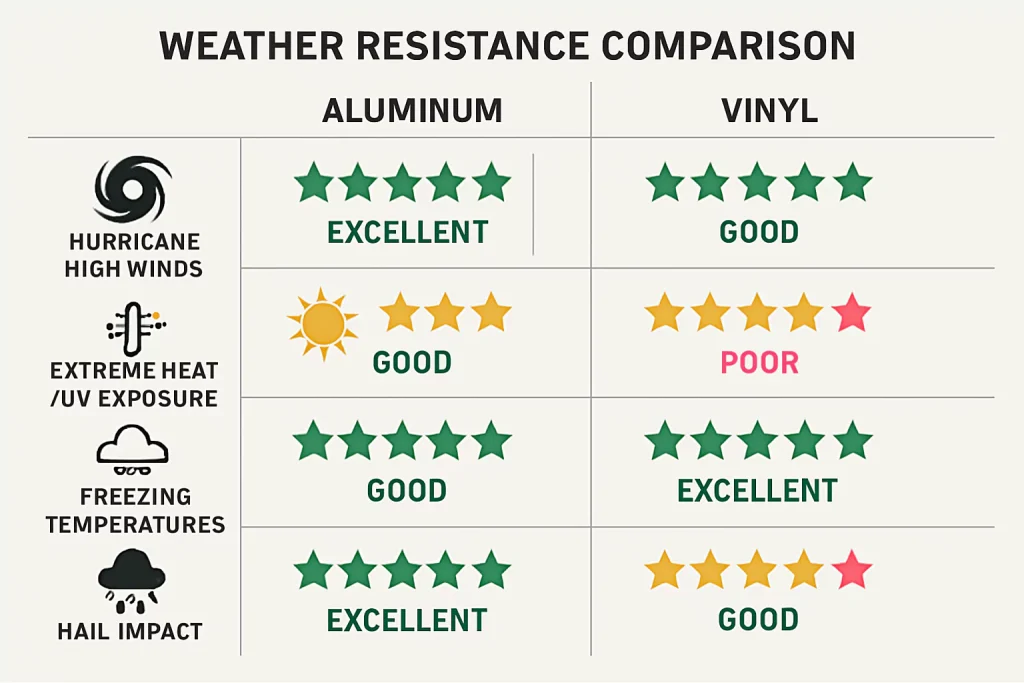
- L'intégrité structurelle est maintenue sous des vents de force ouragan.
Conséquences en matière d'assurance : De nombreux assureurs immobiliers situés en zone côtière exigent désormais des fenêtres « résistantes aux impacts et à la corrosion » pour être couverts. Le vinyle ne répond souvent pas à ces critères ; l’aluminium, si.
💡 Conseil de pro pour les promoteurs immobiliers côtiers :
N’optez pas pour du vinyle pour les propriétés en bord de mer, même si votre budget initial est limité. Vous devrez faire face à des réclamations sous garantie. 5 à 8 ans (farine, décoloration) et défaillance structurelle par années 12-15Ces défaillances ne sont pas couvertes par les garanties décennales habituelles des fabricants de vinyle ; les frais sont donc à votre charge. Le coût initial plus élevé de l’aluminium est… atténuation des risques, pas du luxe haut de gamme.
Résistance et performance structurelle : là où l'aluminium domine
Le principal avantage de l'aluminium n'est pas l'isolation —sa force d'ingénierie.
Capacité de charge (testée en laboratoire, ASTM E330)
| Matériel | Résistance à la traction | Étendue maximale non prise en charge | Largeur typique du cadre | Surface vitrée % |
|---|---|---|---|---|
| Vinyle (standard) | 7 000 à 9 000 psi | 4 à 5 pieds | 3,5 à 5 pouces | 60-70% |
| Vinyle (renforcé) | 9 000 à 12 000 psi | 1,5 à 1,8 mètre | 4 à 6 pouces | 65-72% |
| Aluminium (6063-T5) | 22 000 à 27 000 psi | 8 à 12 pieds | 2 à 3 pouces | 75-85% |
Ce que cela signifie en pratique :
- Grandes ouverturesPour les baies vitrées (de 2,40 à 3 m de haut) ou les portes coulissantes larges (plus de 3,60 m), l'aluminium est structurellement indispensable. Le vinyle nécessite des renforts en acier, ce qui augmente le coût et le poids.
- Profils mincesLes cadres en aluminium peuvent être 40-60% plus fin que le vinyle pour une résistance équivalente → plus de verre, une meilleure vue, une esthétique moderne.
- Zones d'ouragan: Le NOA de Miami-Dade exige une résistance aux chocs + charges de vent de 180 mphLes systèmes en aluminium sont testés selon ces normes ; le vinyle y répond rarement sans renforcement important.
Résistance à la force de levier
| Matériel | Force nécessaire pour dévier de 1/4″ | Niveau de sécurité |
|---|---|---|
| Cadre en vinyle | 250-400 livres | Modéré |
| Cadre en aluminium (2,0 mm) | 800 à 1 200+ livres | Haut |
Pour les applications commerciales ou sensibles en matière de sécurité au rez-de-chaussée : La rigidité de l'aluminium offre une meilleure résistance à l'effraction. Le vinyle, quant à lui, se déforme sous la pression exercée, ce qui permet de déverrouiller la serrure.
Esthétique et flexibilité de conception
Architecture moderne = Domaine de l'aluminium
Les tendances actuelles en matière de design privilégient :
- Murs vitrés du sol au plafond
- Lignes de visée minimales
- Cadres foncés/noirs (contrastant sur les murs blancs)
- Transitions intérieure-extérieure harmonieuses
Pourquoi l'aluminium l'emporte ici :
✅ Profils minces (Largeur du cadre : 2-3 pouces contre 4-5 pouces pour le vinyle)
✅ Options de couleurs illimitées (Le revêtement en poudre accepte toutes les couleurs RAL/personnalisées)
✅ Couleurs sombres stables (Le vinyle noir se déforme au soleil ; l'aluminium est stable jusqu'à 150 °F)
✅ Portée structurelle permet la pose de panneaux de verre de plus de 3 mètres de haut sans meneaux
Là où le vinyle fonctionne mieux :
✅ Styles architecturaux traditionnels (colonial, artisanal, ranch)
✅ Palette de couleurs blanc/beige (couleurs naturelles du vinyle)
✅ Motifs de grille proportionnés (les cadres plus épais en vinyle sont appropriés avec des carreaux divisés)
Stabilité des couleurs
| Matériel | Options de couleur | Résistance à la décoloration par les UV | Déformation thermique |
|---|---|---|---|
| Vinyle | Blanc, beige, taupe, gris (6 à 8 couleurs standard) | Convient aux couleurs claires ; déconseillé aux couleurs foncées (le vinyle noir se dégrade). | Déformations au-dessus de 95-100 °F dans les couleurs foncées |
| Aluminium (revêtement en poudre) | Illimité (toute couleur RAL/personnalisée) | Excellent (le revêtement AAMA 2605 résiste à la décoloration pendant plus de 30 ans) | Stable jusqu'à plus de 150 °F |
Essentiel pour le design moderne : Les fenêtres noires sont à la mode, mais le vinyle noir pose problème. L'aluminium est la solution. seul choix pratique pour les cadres foncés dans les climats chauds.
Exigences d'installation et de maintenance
Complexité de l'installation
Avantages du vinyle :
✅ Léger (30-40% plus léger que l'aluminium) → manipulation plus facile
✅ Coins soudés (soudé par fusion, sans fixations mécaniques) → étanche
✅ Tolérances indulgentes (La flexibilité du matériau absorbe les légers défauts d'alignement)
Exigences relatives à l'aluminium :
⚠️ Plus lourd (Nécessite un équipage de 2 personnes pour les grandes unités)
⚠️ Ancrage précis aux éléments structuraux (sans flexibilité)
⚠️ Inspection de rupture thermique (s'assurer qu'il n'y a pas de ponts métal sur métal)
Différence de coût de main-d'œuvre : $50–100 de plus par fenêtre Pour l'aluminium (équipe expérimentée). Les équipes inexpérimentées peuvent facturer des frais supplémentaires. $150-200 de plus en raison de la difficulté perçue.
Maintenance tout au long de la durée de vie
Les deux matériaux nécessitent peu d'entretien (Il y a égalité)
Tâches courantes (les deux matériaux) :
- Nettoyage annuel : savon doux + eau (vinyle) ou nettoyant pour vitres (aluminium)
- Lubrification des pièces : 1 à 2 fois par an
- Remplacement des joints d'étanchéité : tous les 10 à 15 ans
- Temps requis : 30 à 45 minutes par fenêtre annuellement
Problèmes spécifiques au vinyle :
- Farinage de surface (zones côtières/forte exposition aux UV) : Nettoyer avec un rénovateur de vinyle tous les 2 à 3 ans.
- Décoloration : Non réparable (remplacement complet nécessaire)
- Cadres déformés : non réparables (remplacement complet nécessaire)
Problèmes spécifiques à l'aluminium :
- Corrosion (en cas de revêtement endommagé) : retouches de peinture tous les 10 à 15 ans
- Quincaillerie bloquée : généralement dû à une accumulation de peinture (réparation facile)
Coût d'entretien sur 30 ans :
- Vinyle: $150–200/an = $4,500-6,000 au total
- Aluminium: $100–150/an = $3 000-4 500 au total
L'aluminium permet d'économiser $1 500 à 2 000 en raison d'un nombre réduit de problèmes nécessitant l'intervention d'un professionnel.
Analyse des profits de l'entrepreneur (ce que votre installateur ne vous dira pas)
Cette section s'adresse aux constructeurs, aux entrepreneurs et aux propriétaires avertis qui souhaitent comprendre l'aspect commercial du secteur.
Marge brute par matériau (projet résidentiel de 20 fenêtres)
| Composante de coût | Projet vinyle | Projet aluminium | Différence |
|---|---|---|---|
| Coût des matériaux (prix de l'entrepreneur) | $3,600 | $5,200 | +$1,600 |
| main-d'œuvre d'installation | $3,000 | $3,800 | +$800 |
| Coût total des travaux | $6,600 | $9,000 | +$2,400 |
| Prix de détail au client | $12,000 | $18,000 | +$6,000 |
| Bénéfice brut | $5,400 | $9,000 | +$3,600 |
| marge brute | 45% | 50% | +5 points |
Pourquoi les entrepreneurs préfèrent l'aluminium (lorsque le budget le permet) :
Raison #1 : Profit absolu plus élevé
Même si les marges sont similaires (45% contre 50%), le prix plus élevé de l'aluminium signifie $3,600 de profit supplémentaire par mission. Pour les travailleurs indépendants, cela représente 1 à 2 semaines de revenus supplémentaires pour le même temps de travail.
Raison #2 : Moins de risques liés à la garantie
La durée de vie plus courte du vinyle entraîne un taux de retour plus élevé pour des problèmes survenant pendant la période de garantie de 2 à 5 ans offerte par l'entrepreneur. La stabilité de l'aluminium réduit les risques liés à la garantie.
Raison #3 : Opportunités de vente incitative
Les clients qui optent pour l'aluminium investissent généralement dans des améliorations complémentaires (verre anti-effraction, serrures intelligentes, couleurs personnalisées) → valeur totale du projet plus élevée.
💡 Conseil de pro pour les constructeurs :
Utilisez une spécification hiérarchisée pour optimiser les coûts tout au long d'un développement :
- Rez-de-3e étage (30% unités) : Aluminium (sécurité/exposition côtière)
- 4e étage+ (70% unités) : Vinyle de qualité (performances adéquates, risque moindre)
Pour un projet de 100 unités : Économise $180 000 contre tout aluminium, ajoute $85 000 par rapport au vinyle. Bénéficie des avantages de l'aluminium (80%) à un prix plus abordable (40%).
Cadre décisionnel : Votre situation → Matériau approprié
Choisissez l'aluminium si :
✅ Propriété située à moins de 8 km de l'eau salée (obligatoire pour la longévité)
✅ Architecture moderne/contemporaine nécessitant des montures fines et de grands verres
✅ propriété à long terme (>20 ans) où le coût total sur la durée de vie compte
✅ Immeubles commerciaux/immeubles collectifs là où la durabilité réduit les coûts d'exploitation
✅ Climat chaud (Zone 1-2) là où le vinyle se déforme/se décolore plus rapidement
✅ Fenêtres allant du sol au plafond ou de dimensions surdimensionnées nécessitant une résistance structurelle
✅ Couleurs de cadre foncées (noir, bronze, anthracite) dans les climats ensoleillés
Choisissez le vinyle si :
✅ budget serré exigeant le coût initial le plus bas
✅ Situation intérieure (à plus de 16 km de la côte) avec un climat tempéré
✅ architecture traditionnelle (colonial, artisanal) là où des cadres plus épais conviennent
✅ Climat froid (zones 6 à 8) là où l'optimisation de l'isolation est cruciale
✅ propriété à court terme (moins de 10 ans) où le remplacement ne sera pas votre problème
✅ Couleurs claires uniquement (blanc, beige, brun clair) dans un cadre résidentiel
L'approche hybride (le meilleur des deux mondes)
Pour les propriétés à risque mixte:
- Façade de la maison + fenêtres visibles: Aluminium (esthétique, longévité)
- Fenêtres arrière/latéralesVinyle (économies sur les zones peu visibles)
Pour les bâtiments à plusieurs étages:
- Rez-de-chaussée-4e étage: Aluminium (sécurité, résistance aux intempéries)
- 5e étage+Vinyle (risque moindre, performances adéquates)
Fenêtres en vinyle ou en aluminium (FAQ)
Puis-je peindre des fenêtres en vinyle pour en changer la couleur ?
- Adhère mal (s'écailler/s'effriter avec le temps)
- Piège à chaleur, notamment avec les couleurs foncées, augmentant le risque de déformation/cintrage
- Potentiellement annuler la garantie du fabricant
Les fenêtres en aluminium condensent-elles ou givrent-elles en hiver ?
aluminium à rupture de chaleur moderne Elle utilise une bande isolante en polyamide pour séparer les parties métalliques intérieures et extérieures. Correctement conçue, elle offre une résistance à la condensation comparable à celle d'un vinyle de qualité.
Lors de vos achats, demandez : « Est-ce une rupture de pont thermique, et quelle est la largeur de cette rupture ? » Dans les climats plus froids, de très petites interruptions (souvent inférieures à ~14 mm) sont généralement insuffisantes par rapport aux conceptions à rupture thermique plus larges.
Les fenêtres en vinyle augmentent-elles la valeur de ma maison ?
- Vous remplacez vieilles fenêtres en bois ou à simple vitrage (confort + économies d'énergie)
- Vous êtes sur un marché où Le vinyle est ce à quoi on s'attend « normalement ».
- Vos fenêtres actuelles sont visiblement usé, embué ou endommagé
- Vous êtes dedans côtier ou dans des zones exposées à des conditions extrêmes où la durabilité est un critère d'achat primordial
- La maison est moderne/luxe où l'aluminium est perçu comme un matériau de qualité supérieure
- C'est un immeubles commerciaux/multifamiliaux propriété où les coûts d'exploitation à long terme sont importants
Quelle est la différence de délai de livraison entre les fenêtres en vinyle et les fenêtres en aluminium ?
- Projets standard (20 à 40 fenêtres) : Vinyle 3 à 6 semaines; aluminium à rupture de pont thermique 6 à 8 semaines
- Projets sur mesure/de grande envergure (plus de 50 fenêtres, couleurs personnalisées) : Vinyle 6 à 10 semaines; aluminium 8 à 12 semaines
Pourquoi choisir Hotian pour votre projet en aluminium ou en vinyle ?
Nous fabriquons les deux matériaux car nous savons qu'il n'existe pas de solution « idéale » universelle ; le bon choix dépend de la zone climatique de votre bâtiment, de son style architectural, de votre budget et de la durée de possession.
Nos avantages en matière de fabrication
Systèmes en aluminium à rupture de pont thermique
- Rupture de pont thermique standard en polyamide de 24 mm (et non de qualité économique de 14 mm)
- Revêtement en poudre AAMA 2605 (résistance à la décoloration de 40 ans)
- Options certifiées résistantes aux impacts par la NOA de Miami-Dade pour les zones d'ouragan
- Coefficient U réduit à 0,30 avec un vitrage approprié (performance équivalente à celle du vinyle)
- Correspondance personnalisée des couleurs RAL disponible
Systèmes de vinyle de qualité commerciale
- Profilés multichambres avec options d'isolation en mousse
- Coins soudés par fusion (sans fixations mécaniques) pour cadres étanches
- Quincaillerie en acier inoxydable (option côtière disponible)
- Coefficient U de 0,26 à 0,30 selon la configuration
- Options de garantie transférable de plus de 20 ans (cadre et quincaillerie)
Assistance aux projets (plus de 20 commandes de fenêtres)
- Prix direct usine (élimination des marges des distributeurs)
- Dossiers de soumission (détails CAO, rapports d'essais, spécifications)
- Formation à l'installation pour votre équipe (sur site ou virtuelle)
- Remises sur volume : généralement de 15 à 251 TP3T de réduction pour 50 unités ou plus
💡 Conseil de pro pour les grands projets :
Planifiez une visite de notre usine (virtuelle ou en présentiel) pendant la phase de conception. Découvrez le processus d'assemblage des ruptures thermiques, les tests de contrôle qualité et la manutention des matériaux. Comprendre le processus de fabrication vous permettra de distinguer les fonctionnalités essentielles de celles qui relèvent du marketing. Nous accueillons chaque année des dizaines d'équipes projet ; la plupart d'entre elles considèrent cette visite comme l'heure la plus utile de leur recherche de spécifications.
Passer à l'action : Prochaines étapes selon le type d'utilisateur
🏠 Pour les propriétaires
Actions immédiates :
- Déterminez votre exposition climatique (5 min) :
- Vérifiez votre zone climatique : Carte des zones ENERGY STAR
- Mesurer la distance jusqu'à la côte : Google Maps
- Résultat : Réduit le choix des matériaux à 1 ou 2 options réalistes.
- Calcul du coût total sur toute la durée de vie (10 min) :
- Utilisez le tableau du coût total de possession (TCO) sur 50 ans ci-dessus.
- À prendre en compte : la durée pendant laquelle vous prévoyez de rester propriétaire de la maison.
- Résultat : Comprendre l'investissement total, et pas seulement le prix affiché.
- Obtenez des devis comparatifs (cette semaine) :
- Demander des devis pour les deux matériaux (ne pas décider à l'avance).
- Assurez-vous que les devis pour l'aluminium comprennent rupture de pont thermique spécifications.
- Comparer : coût initial, garantie, coefficient U, durée de vie.
Consultez notre catalogue de fenêtres en aluminium →
Consultez notre catalogue de fenêtres en vinyle →
🏗️ Pour les entrepreneurs et les constructeurs
Actions de planification du projet :
- Téléchargez les modèles de spécifications (dès aujourd'hui) :
- Aluminium : détails CAO, rapports d'essais ASTM, fiches de soumission.
- Vinyle : Données de conformité énergétique, normes d'installation.
- Demande de tarif dégressif (cette semaine) :
- 20+ fenêtres : cible 15-18% remise.
- 50+ fenêtres : remise 20-25% + préparation de soumission gratuite.
- Plus de 100 fenêtres : Tarification personnalisée + formation sur site.
- Planifier la consultation sur les matériaux (phase de conception) :
- Analyse : Emplacement du bâtiment, style architectural, objectifs budgétaires.
- Réception : Recommandation de matériel optimisée par ouverture.
- Calendrier : appel d’une heure ou réunion sur place