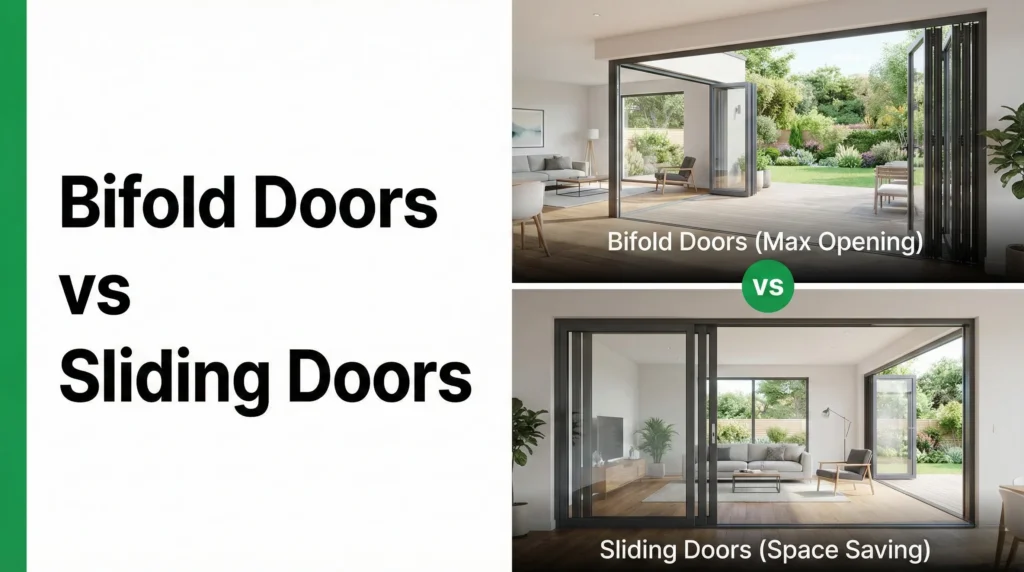
French doors remain a popular choice for residential projects—but they’re not always the right choice. They require more planning than sliding doors, cost more, and work better in some applications than others. For contractors, the key decisions are when French doors make sense versus sliding, which configuration to specify, and whether to go inswing or outswing.
This guide covers what contractors need to know to specify French doors correctly for different project types.
Que sont les portes françaises ?
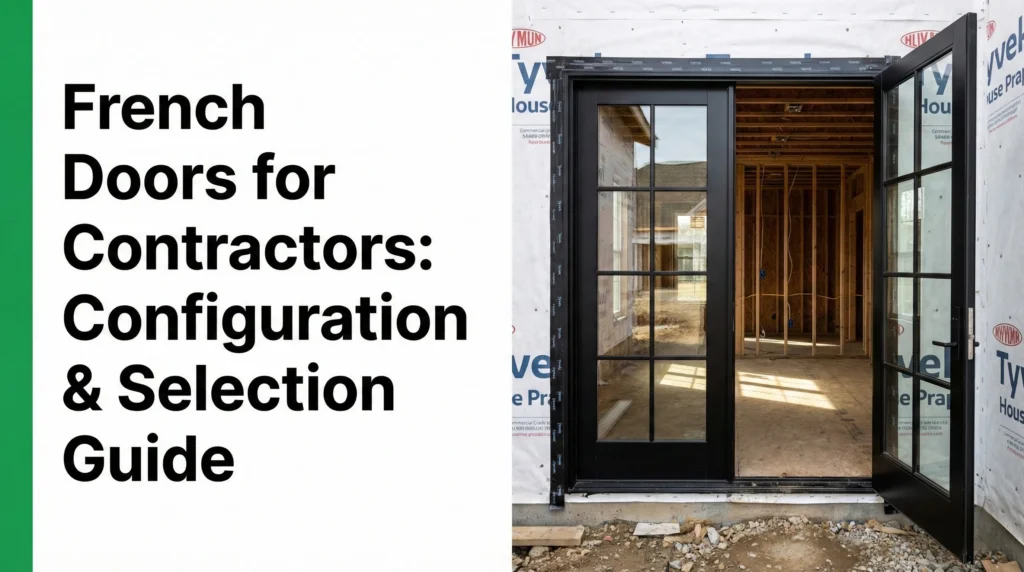
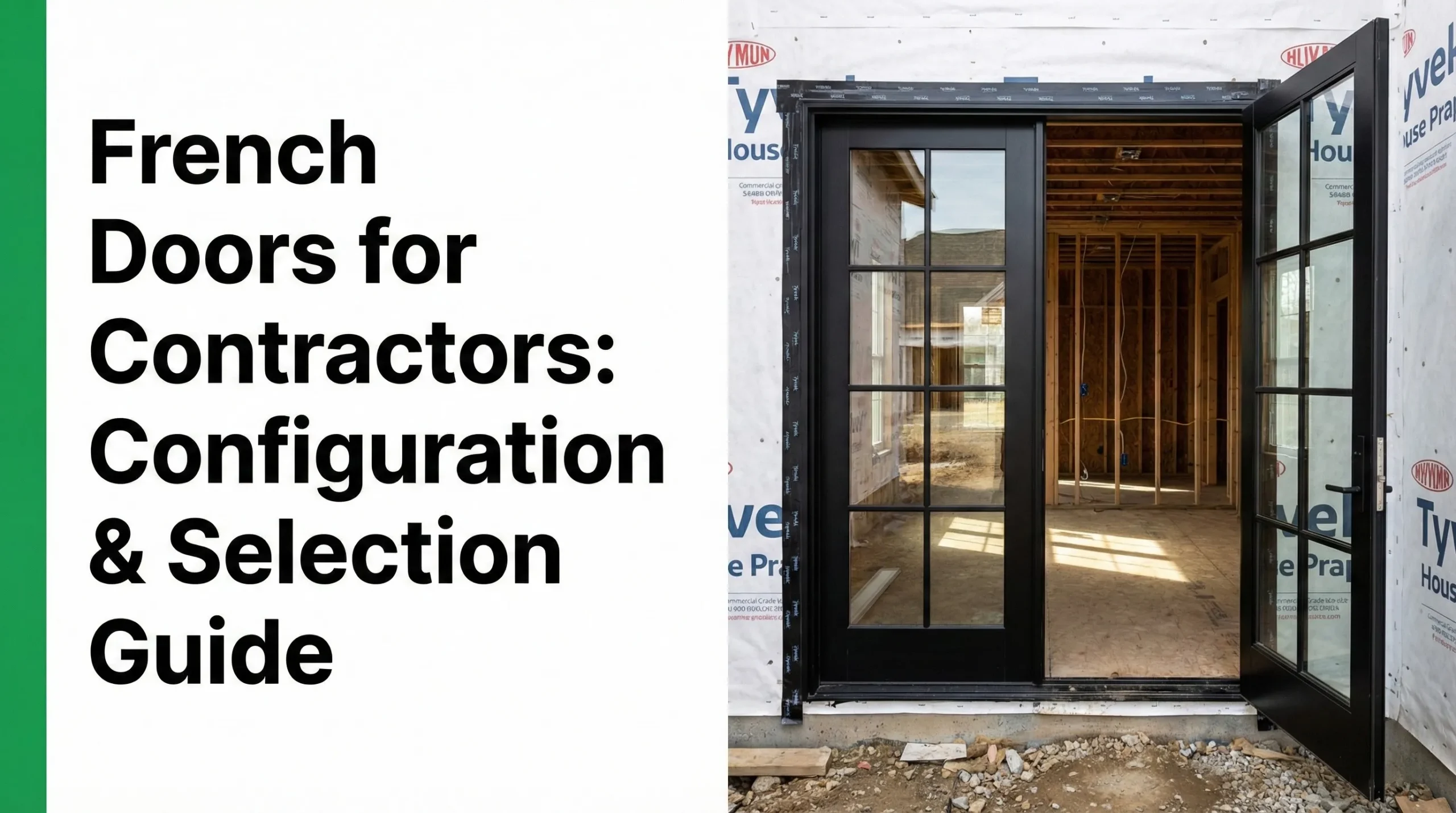
French doors are exterior hinged patio doors with predominantly glazed panels, typically used to connect interior living spaces to outdoor areas. They consist of two panels that swing open on hinges, typically meeting in the middle. Unlike sliding doors, where panels glide on tracks, french doors operate on hinges and require swing clearance either inside the room or outside on the patio.
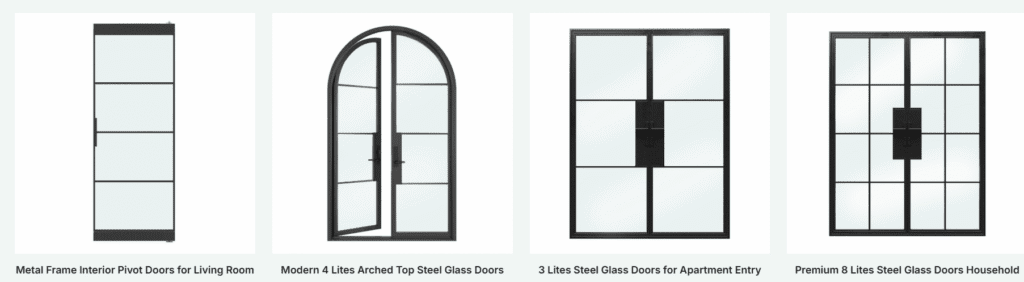
Key Characteristics:
- Two panels: Can be both operable (double door) or one fixed + one operable (single active)
- Mostly glass: Larger glass area than traditional panel doors, often with divided lite patterns (muntins)
- Hinged operation: Swing open rather than slide
- Center meeting point: Panels meet at an astragal (vertical trim piece between doors)
Common Applications:
- Master bedroom or living room to patio/deck
- Ground-floor units in multi-unit buildings (when aesthetics justify the cost)
- Custom homes where traditional or elegant aesthetic is desired
- Interior room dividers (not covered in this guide—focus is exterior patio doors)
Not All Glass Doors Are French Doors:
Sliding glass doors are often mistakenly called french doors. If it slides, it’s a sliding door. If it swings on hinges, it’s french (or hinged patio door).
Configuration Options: What Contractors Need to Specify
Single Panel vs Double Panel
Single Panel (One Active, One Fixed):
- How it works: One panel opens on hinges, the other is fixed in place
- Ouverture claire: ~50% of total door width (only one panel opens)
- Coût: Lower than double panel (hardware on one panel only)
- Idéal pour: Standard residential projects, budget-conscious applications, locations where full opening width isn’t needed
Double Panel (Both Active):
- How it works: Both panels open on hinges, meeting in the middle when closed
- Ouverture claire: ~100% of total door width when both panels open
- Coût: Higher (requires hardware, hinges, and weathersealing for both panels)
- Idéal pour: Custom homes, applications needing wide clear opening (moving furniture, indoor-outdoor entertaining), high-end projects
Contractor Decision Factor:
If the homeowner or project doesn’t specifically need the full opening width, single panel saves cost without sacrificing much functionality. For multi-unit projects, single panel is almost always more cost-effective.
Inswing vs Outswing: The Critical Decision
This is where most specification mistakes happen. Choosing the wrong swing direction can create functional problems or require expensive field changes.
Inswing French Doors (Opens Into Room)
How They Work:
Doors swing into the interior space. Hinges are on the interior side of the frame.
Avantages :
- Plus sécurisé: Hinges are inside, can’t be tampered with from exterior
- Better for snow climates: Snow accumulation outside won’t block door from opening
- Standard for multi-unit projects: Easier to standardize across all units
- Simpler hardware: Standard residential-grade hinges and locks work fine
Disadvantages:
- Requires interior floor space: Door arc occupies 5-6 feet of floor space when fully open
- Furniture placement conflicts: Door swing can interfere with kitchen islands, furniture, or interior layout
- Can feel intrusive: Doors swing into living space, may disrupt room flow
Idéal pour :
- Multi-unit residential (apartments, condos) for consistency
- Areas with snow accumulation (northern climates)
- Standard residential where security is a priority
- Tight budgets (no special hardware required)
Outswing French Doors (Opens Onto Patio)
How They Work:
Doors swing outward onto the patio or deck. Hinges are on the exterior side.
Avantages :
- Saves interior space: No door arc occupying interior floor space
- Easier furniture placement: No need to plan around door swing inside
- Better for tight rooms: Works in smaller rooms where inswing would crowd the space
- Better weathersealing potential: When wind pushes against closed doors, they seal tighter against the frame
Disadvantages:
- Plus cher: Requires special weather-resistant hinges and enhanced weatherstripping (adds 10-15% to cost)
- Hinge exposure: Hinges are outside, need tamper-resistant design or hinge shields
- Snow accumulation issues: Snow outside can block doors from opening (problem in northern climates)
- Wind exposure: In high-wind or coastal areas, doors can be blown open unless properly latched
Idéal pour :
- Custom homes with space constraints inside
- Mild climates (no snow concerns)
- Modern or contemporary designs where outswing is aesthetic preference
- Projects where interior space preservation justifies the extra cost
Decision Framework: Inswing or Outswing?
Use this framework when specifying:
| Facteur | Choose Inswing | Choose Outswing |
|---|---|---|
| Climat | Snow-prone areas ✅ | Mild climates ✅ |
| Interior Space | Adequate floor space ✅ | Tight rooms ✅ |
| Type de projet | Multi-unit residential ✅ | Custom homes (case-by-case) ✅ |
| Budget | Cost-conscious ✅ | Budget allows 10-15% premium ✅ |
| Security Priority | High (hinges inside) ✅ | Moderate (with tamper-resistant hinges) ⚠️ |
| Furniture Layout | Flexible layout ✅ | Fixed layout (island, built-ins) ✅ |
Contractor Tip:
For multi-unit projects, specify inswing across all units for consistency and cost control. For custom homes, walk the space (or review floor plans) to confirm which direction works better for the specific layout.
Code & Egress Considerations
For any door in a required egress path, always verify local code requirements for swing direction and clear width. Some jurisdictions have specific requirements:
- Egress doors may be required to swing outward (away from building) for emergency exit
- Clear width minimums must be maintained when door is open at 90 degrees
- Maneuvering clearances on both sides of door (especially for accessible units)
- Landing requirements for doors that swing outward onto decks or patios
Consult with the architect or code official early in the design process if the door serves as an egress path.
French Doors by Project Type
Multi-Unit Residential (Apartments, Condos)
Retour à la réalité :
French doors are LESS common in multi-unit projects than sliding doors—and for good reason.
Why Sliding Doors Are Usually Better for Multi-Unit:
- More cost-effective for bulk orders
- No swing clearance issues in smaller units
- Easier to standardize across dozens or hundreds of units
- Simpler installation coordination
When French Doors DO Make Sense in Multi-Unit:
- Ground-floor units with patio access: French doors as a premium feature to justify higher pricing for ground-floor units
- Luxury condos: High-end projects where aesthetics justify the cost premium
- Larger units: Master bedrooms in 2BR+ units where space allows for swing clearance
- Penthouse or top-floor units: Premium units where developers want differentiation
Considerations for Multi-Unit:
- Always specify inswing for consistency and to avoid snow issues (unless building is in mild climate with no snow)
- Single panel configuration is more cost-effective (double panel rarely necessary)
- ADA compliance for ground-floor: Verify clear width meets 32-inch minimum when door is open at 90 degrees
- Bulk order lead time: 6-8 weeks typical for custom configurations; plan ahead
Custom Single-Family Homes
Most Flexibility Here:
Custom homes offer the most freedom to choose french doors based on design intent, homeowner preference, and budget.
When French Doors Make Sense:
- Homeowner specifically wants traditional or elegant aesthetic
- Master bedroom or living room opening to large patio/deck
- Full opening width needed for indoor-outdoor entertaining
- Architectural style is traditional, transitional, or French country
Configuration Choices:
- Inswing vs outswing: Depends on interior layout and climate (use decision framework above)
- Single vs double panel: Double panel more common in custom homes (homeowners willing to pay for full opening)
- With sidelights: Fixed glass panels on one or both sides of french doors expand glass area and light—popular in high-end projects
Contractor Coordination:
- Confirm swing direction with homeowner EARLY (before framing)
- Walk the space to verify no furniture conflicts
- Discuss trade-offs (cost, space, function) upfront
Renovation Projects
Working with Constraints:
Renovations limit your options because you’re often working with existing rough openings and structural limitations.
When Replacing Existing Doors:
- Sliding to sliding: Easiest replacement, reuse existing RO
- Sliding to french: Possible but requires verifying adequate swing clearance (interior or exterior)
- French to french: Can reuse RO if replacing same configuration; measure carefully
Configuration Changes Require Planning:
- Switching from sliding to french (or vice versa) may require RO modifications
- Changing from inswing to outswing (or vice versa) requires re-framing hinge and lock sides
- Adding sidelights requires widening the RO
Cost vs Benefit:
French doors add aesthetic value in renovations—homeowners often willing to pay the premium for the look. But verify swing clearance before committing. Discovering mid-project that the door arc conflicts with a kitchen island is an expensive mistake.
Light Commercial (Small Offices, Cafes, Boutique Hotels)
French Doors Work—But With Caveats:
Where They Make Sense:
- Boutique hotels (guest rooms to private patios)
- Cafes or restaurants (dining room to small patio—aesthetic appeal)
- Small professional offices (conference room to terrace)
Where They DON’T Make Sense:
- High-traffic commercial spaces (sliding or bifold better for traffic flow)
- Large restaurant patios with staff carrying trays (need wider clear opening than french doors provide)
Commercial-Specific Requirements:
- Commercial-grade hardware: Heavier-duty hinges, multipoint locks rated for higher cycle counts
- verre feuilleté: Required for safety and security in most commercial applications
- Durabilité: Aluminum frames more durable than vinyl for commercial use
- Conformité à l'ADA: Verify maneuvering clearances and operating force requirements
Security Considerations: What Contractors Should Specify
Why French Doors Have a Security Reputation Problem
French doors are often perceived as less secure than sliding doors, and there’s some truth to that:
- Glass panels: Large glass area easier to break than solid doors
- Center seam: Two panels meet in the middle, creating a potential weak point if not properly secured
- Outswing hinge exposure: Outswing doors have hinges on the exterior (can be tampered with if not protected)
Security Solutions for Different Applications
Standard Residential (Low-Risk Locations):
- Multipoint locking system: Locks engage at 3 points along the frame (top, middle, bottom) instead of just one
- verre trempé: Standard for safety; breaks into small pieces rather than shards
- Flush bolts on passive panel: Top and bottom bolts lock passive panel into frame, preventing prying
Ground-Floor or High-Risk Residential:
- verre feuilleté: Two layers of glass with interlayer film—holds together when broken, deters smash-and-grab
- Reinforced astragal: Stronger center seam where panels meet
- Tamper-resistant hinges (for outswing): Hinge pins can’t be removed from outside
Applications commerciales :
- Commercial-grade multipoint locks: Higher cycle rating, heavier construction
- Laminated or impact-rated glass: Required by code in many commercial applications
- Access control integration: Electronic locks or card readers if needed
For More Detail:
For project teams needing more detail on hardware specifications and glazing options, see our full technical guide: Comment sécuriser les portes-fenêtres
Materials & Performance
Matériaux du cadre
Aluminium:
- Idéal pour: Commercial projects, coastal areas, modern designs, large panels
- Avantages: Strength, corrosion resistance, slim profiles (more glass area), durability
- Inconvénients: Higher cost, requires thermal breaks for energy efficiency in extreme climates
Vinyle:
- Idéal pour: Budget-conscious residential, standard homes, multi-unit projects
- Avantages: Cost-effective, naturally energy-efficient (no thermal breaks needed), low maintenance
- Inconvénients: Wider frame profiles (less glass area), lower structural strength limits panel size
Wood-Clad:
- Idéal pour: Custom homes, traditional or high-end designs
- Avantages: Premium aesthetic, interior wood finish options, exterior aluminum or vinyl cladding protects wood
- Inconvénients: Higher cost, more maintenance (interior wood surfaces)
Composite / Fiberglass:
- Idéal pour: Harsh climates (coastal, extreme temperature swings), low-maintenance projects
- Avantages: Superior durability in extreme weather, dimensionally stable (won’t warp/expand), low maintenance, can mimic wood appearance
- Inconvénients: Higher cost than vinyl, less common (longer lead times), limited color options
Some manufacturers also offer composite or fiberglass frames for improved durability and reduced maintenance in harsh climates. These materials combine benefits of wood (strength, aesthetics) and vinyl (low maintenance) but at a premium price point.
Glass & Energy Performance
Standard Configuration:
- Double-pane insulated glass with Low-E coating (meets energy codes in most climates)
- verre trempé for safety (required by code for doors)
- Remplissage au gaz argon between panes improves insulation
Upgrades for Specific Needs:
- Verre triple vitrage: Cold climates or high-performance projects (better U-factor but higher cost and weight)
- verre feuilleté: Security or sound reduction (laminated layer dampens sound transmission)
- Low SHGC glass: Hot climates where solar heat gain needs to be minimized
- Higher SHGC glass: Cold climates where passive solar heat is beneficial
Energy Code Compliance:
- Verify local code requirements for U-factor and SHGC
- Northern climates: Lower U-factor priority (heat retention)
- Southern climates: Lower SHGC priority (block solar heat)
Common Specification Mistakes to Avoid
1. Choosing French Doors When Sliding Would Work Better
The Mistake:
Specifying french doors because the homeowner “likes the look” without verifying swing clearance.
The Consequence:
Door swing conflicts with furniture, interior layout, or patio features. Discovered during installation or after move-in.
The Fix:
Walk the space or review floor plans for swing clearance before specifying french doors. If space is tight, sliding doors avoid the problem entirely and cost less.
2. Wrong Swing Direction for Climate
The Mistake:
Specifying outswing french doors in a snow-prone climate because it saves interior space.
The Consequence:
Snow accumulation outside blocks doors from opening. Homeowner can’t access patio after snowstorm without shoveling first.
The Fix:
Inswing for climates with regular snow. Outswing only in mild climates or where snow management is guaranteed.
3. Under-Specifying Security for Vulnerable Applications
The Mistake:
Using standard residential locks and tempered glass for ground-floor units or commercial applications.
The Consequence:
Higher break-in risk, insurance issues, or code violations (commercial projects often require laminated glass).
The Fix:
Ground-floor residential: Multipoint locks + laminated glass. Commercial: Commercial-grade hardware + laminated glass. Verify code requirements.
4. Not Coordinating Swing Direction with Interior Layout
The Mistake:
Specifying inswing french doors without checking floor plan—door arc conflicts with kitchen island or built-in furniture.
The Consequence:
Doors hit furniture when opened, or can’t open fully. Requires changing door swing (expensive field change) or moving furniture.
The Fix:
Review floor plans to confirm door swing arc doesn’t conflict with fixed elements. For custom homes, involve homeowner in decision early.
5. Assuming French Doors Cost the Same as Sliding
The Mistake:
Budgeting french doors at same cost as sliding doors, then facing overruns when actual pricing comes in.
The Consequence:
Budget shortfall forces downgrade to sliding doors (aesthetic compromise) or cuts elsewhere.
The Fix:
French doors typically cost 15-30% more than sliding doors of the same size. Outswing adds another 10-15%. Budget accordingly from the start.
When French Doors Make Sense vs Sliding Doors
Use this decision matrix when specifying:
| Facteur | Portes françaises | Portes coulissantes |
|---|---|---|
| Aesthetic Goal | Traditional, elegant ✅ | Modern, minimalist ✅ |
| Clear Opening Needed | Full width (double panel) ✅ | 50% width ⚠️ |
| Interior Space | Adequate swing clearance ✅ | Tight spaces ✅ |
| Budget | Higher budget ✅ | Cost-conscious ✅ |
| Type de projet | Custom homes ✅ | Multi-unit residential ✅ |
| Entretien | Hinges, weatherstripping ⚠️ | Rollers, tracks ⚠️ |
Règle générale :
If the project has space for swing clearance, budget allows the premium, and aesthetics justify the choice—french doors work. If any of those conditions aren’t met, sliding doors are the safer, more practical choice.
Lead Time & Project Planning
Typical Lead Times:
- Custom french doors: 6-8 weeks from order to delivery
- Bulk orders (multi-unit projects): May extend to 8-10 weeks depending on quantity
Why This Matters:
French doors are typically installed after framing and rough-in, before interior finishes. Late delivery holds up the entire project schedule.
Contractor Planning Tip:
For custom homes: Confirm swing direction and configuration with homeowner before ordering (changing your mind after manufacturing starts is expensive or impossible).
For multi-unit projects: Confirm RO dimensions from first few completed units before placing bulk order for remaining units. Avoids ordering all doors upfront based on plans that may change during framing.
Conclusion: Specifying French Doors Correctly
French doors add aesthetic value to residential projects, but they require more planning than sliding doors. The key decisions contractors need to make:
- Configuration: Single panel (cost-effective) vs double panel (full opening width)
- Swing direction: Inswing (more secure, better for snow) vs outswing (saves interior space but costs more)
- When they make sense: Custom homes and ground-floor premium units—less common in standard multi-unit projects
- Sécurité: Multipoint locks and laminated glass for vulnerable applications
- Matériels: Aluminum for commercial/large panels, vinyl for cost-conscious residential
- Code compliance: Verify egress requirements early in design
French doors aren’t the default choice for every patio door opening—but when the application justifies them, they deliver the aesthetic and functional benefits homeowners want.
Prochaines étapes :
For project-specific guidance on french door configurations, custom sizing, or bulk order pricing, Contactez-nous early in the design process. Custom doors require 6-8 weeks lead time, so early coordination keeps projects on schedule.